How Do Podcasts Make Money in 2026: 11 Revenue Models
How do podcasts make money? Most podcasts make money by combining a few revenue streams rather than relying on one. The common ones are host-read sponsorships, programmatic ads, listener memberships and subscriptions, affiliate commissions, selling your own services or products, merch, live events, video on YouTube, and licensing. Bigger shows lean on advertising. Smaller shows usually earn more, faster, from services, affiliates, and paid communities, because those do not need huge download numbers.
This is the honest part most guides skip: the average podcast gets about 129 downloads per episode, only around 7% of shows clear 5,000 downloads per episode, just 2% reach 20,000, and roughly 1% pass 37,000. Ad income scales with those numbers, so if your audience is small the fastest path to revenue is almost never ads. It is selling something your specific listeners want.
The good news: you do not need a million listeners. A focused show with 1,000 to 3,000 engaged listeners can earn through sponsorship, affiliates, a membership, or its own offer. This guide breaks down all 11 models, with real CPM rates, listener thresholds, and what each one actually pays, then gives you a plan based on your show size.
How much money do podcasts make?
There is no single number, because income depends on downloads, niche, and how many revenue streams you run. Rough, realistic ranges for shows that monetize on purpose:
| Show size (downloads/episode) | Typical monthly revenue | Best revenue bets |
|---|---|---|
| Under 1,000 | $0 to a few hundred | Services, affiliates, templates, tip jar, email list |
| 1,000 to 5,000 | A few hundred to ~$2,000 | Niche sponsors, memberships, workshops, affiliates |
| 5,000 to 20,000 | ~$1,000 to $10,000 | Host-read sponsorships, paid feed, video clips |
| 20,000 to 100,000 | ~$10,000 to $50,000+ | Direct ads, programmatic, events, products |
| 100,000+ | $50,000 to $100,000+ | Multiple ad slots, network deals, premium products, video |
For reference at the top end: Joe Rogan's show reportedly earns roughly $80,000 per episode, Tim Ferriss has cited around $60,000 per episode, and shows like The Diary of a CEO report seven-figure annual revenue. Those are outliers. A more typical full-time podcaster earns somewhere between $30 and $50 per working hour once a few streams are running, which is closer to what most people building a podcast business should plan around.
Quick answer: the 11 ways podcasts make money
| Revenue model | Best for | What you need first |
|---|---|---|
| Host-read sponsorships | Niche shows with audience trust | A clear audience profile and download data |
| Programmatic ads | Higher-volume shows | Consistent downloads and host or platform ad support |
| Listener memberships | Community-driven shows | A reason to pay beyond the free feed |
| Premium episodes | Educational, narrative, or fan shows | Bonus content people actually want |
| Affiliate offers | Review, education, business, hobby shows | Products you can honestly recommend |
| Services or consulting | Expert-led shows | A clear path from episode to inquiry |
| Courses and templates | Teaching shows | Repeat listener problems you can package |
| Merch | Fan, comedy, culture, identity shows | Memorable phrases or a strong visual identity |
| Live events | Local, personality, or community shows | Engaged listeners in a shared place or niche |
| YouTube and video | Shows with visual clips or interviews | Watchable edits and captions |
| Licensing and syndication | Research, story, or archive shows | Original material with reuse value |
1. Host-read sponsorships
Host-read sponsorships are still the premium model because they borrow the trust between host and listener. The sponsor is not just buying impressions, they are buying context. The numbers back this up: surveys show nearly half of listeners trust podcast hosts about as much as their own friends, and around 81% say they have taken action after a host-read ad.
Sponsorships are priced on CPM, the cost per thousand downloads. In 2026 typical host-read CPMs run roughly:
- Pre-roll (before the content): about $15 to $20 per thousand
- Mid-roll (in the middle, the highest value slot): about $20 to $30 per thousand
- Post-roll (after the content): about $15 to $20 per thousand
The average across podcasting sits near $20 to $25 CPM, with high-value niches like B2B, finance, and technology pushing $30 or more. A simple example: a show with 5,000 downloads per episode running one $25 mid-roll earns about $125 per episode, or roughly $500 a month at weekly cadence. Add a pre-roll and post-roll and that can climb past $1,000 a month.
To sell sponsorships well, prepare a simple media kit with:
- Monthly downloads and average episode downloads after 7, 30, and 90 days
- Audience geography, job role, interests, or niche identity
- Example placements: pre-roll, mid-roll, post-roll, newsletter, and social clip
- A sample script written in your voice
- Clear pricing and renewal options
Host-read ads work best when the product naturally fits the audience. A cybersecurity podcast can credibly promote security training. A parenting podcast can promote family planning tools. A random sponsor with no audience fit usually performs poorly and weakens trust. Always disclose paid placements to stay compliant with FTC rules.
2. Programmatic and platform ads
Programmatic ads are filled automatically through dynamic ad insertion, so inventory sells without you pitching each brand. The tradeoff is control and rate. You usually earn less per placement than a direct host-read sponsor, and the ad feels less native to the show.
The big platform shift in 2026 is the Spotify Partner Program, which pays creators from ads and Spotify Premium video views. To qualify you need at least 3 published episodes, 1,000 unique listeners, and 2,000 listening hours on Spotify in the trailing 30 days, thresholds Spotify lowered substantially in early 2026 (eligibility criteria can change at any time). Spotify reported paying creators over $100 million in a single recent quarter, and hundreds of shows have passed $10,000 a month through it.
Use programmatic ads when you have consistent volume and want a baseline. Use direct host-read sponsorships when your niche is valuable enough that a brand will pay for relevance. Most growing shows run both.
3. Listener memberships
A paid membership can work with a smaller audience if listeners feel connected to the host or community. The mistake is offering vague "bonus content." Be specific. Platforms like Patreon, Apple Podcasts subscriptions, Supercast, and Memberful make the billing and private feed easy.
Membership perks that actually convert:
- Ad-free episodes
- Bonus Q&A episodes
- Private community access (Discord, Slack, or a forum)
- Early access to interviews
- Monthly workshops or live calls
- Downloadable templates or research notes
- Behind-the-scenes production breakdowns
The best membership pitch is not "support the show." It is "get closer to the work you already value." A show with 3,000 weekly listeners converting even 2% to a $7 tier earns over $400 a month before any ad sells.
4. Premium episodes and private feeds
Premium feeds work when your audience has a reason to pay for more depth. Education, investing, industry analysis, language learning, true crime, and fandom shows can all support a paid tier. Apple Podcasts Subscriptions and Spotify both let you publish subscriber-only episodes directly in the same feed.
Before launching a recurring premium feed, test demand with a single paid workshop, a downloadable guide, or a limited bonus series. If nobody buys a small one-off offer, a monthly premium feed will be harder to sustain. Note that Apple takes a 30% cut in year one, dropping to 15% after a subscriber's first year, so price with the platform fee in mind.
5. Affiliate revenue
Affiliate revenue fits podcasts that recommend tools, books, software, courses, equipment, or services. You share a unique link or code and earn a commission when listeners buy. It works at almost any audience size because it pays on conversions, not impressions.
The strongest affiliate segments are specific and experience-based:
- Why you chose the product
- Who it is good for
- Who should avoid it
- What changed after you used it
- Any limitations or hidden costs
Disclose affiliate relationships clearly. That protects trust and helps listeners evaluate the recommendation. Pair the spoken mention with a clean link in your show notes and a pinned comment so people can actually act on it.
6. Services, consulting, and client work
For expert-led shows, the podcast itself is the top of the funnel. You may not need huge download numbers if the show brings in the right client conversations. One marketing podcaster reportedly landed a $15,000 contract straight from a guest relationship built on the show.
This works especially well for consultants, agencies, coaches, lawyers, accountants, designers, recruiters, educators, and B2B founders. Each episode should make your expertise visible and make the next step obvious: book a call, download a checklist, join a webinar, or request a proposal. A single client from a niche B2B show can outearn a year of ads.
7. Courses, templates, and digital products
If listeners ask the same questions repeatedly, turn the answer into a product. Examples:
- A course built on your most popular topic cluster
- Notion, spreadsheet, or checklist templates
- Interview prep packs
- Research databases
- Script templates
- Production workflow kits
Use your podcast to identify demand before you build. The best product ideas come from listener questions, not brainstorming sessions. Host courses on platforms like Teachable, Kajabi, or Skillshare, and mention them in the natural moments where a listener is already feeling the problem you solve.
8. Merch
Merch works when the show has identity. A logo alone is rarely enough. Strong merch is built around catchphrases, inside jokes, visual style, and the feeling of being part of the community. Common products are shirts, hoodies, mugs, stickers, and posters.
Start with low-risk print-on-demand so you hold no inventory: a service prints and ships only what sells. Run limited drops to create urgency, and watch which designs move before you commit to a bulk order. Merch is rarely a primary income source, but it strengthens community and adds a steady trickle.
9. Live events
Live events can be profitable even for niche shows. Think smaller than a theater tour: workshops, meetups, live interviews, panels, retreats, and virtual events. Revenue comes from tickets, sponsors, recordings, VIP access, or follow-on products.
Events also create excellent marketing material. A recorded live show becomes bonus episodes, social clips, and testimonials that sell the next event. Even a single sold-out room of 50 superfans at $40 a ticket is $2,000 plus whatever you sell on the back end.
10. Video, YouTube, and social clips
Video gives a podcast more surfaces to be discovered, and YouTube has become a primary podcast platform in its own right. Monetized channels typically earn roughly $3,000 to $5,000 per million views from ads, on top of the discovery boost that drives new listeners to your audio feed and offers.
A reliable repurposing workflow:
- Record the episode.
- Export the full audio.
- Cut a captioned short for the single best moment.
- Create a quote graphic or an audiogram (a waveform clip).
- Link back to the full episode, your email list, and any offer.
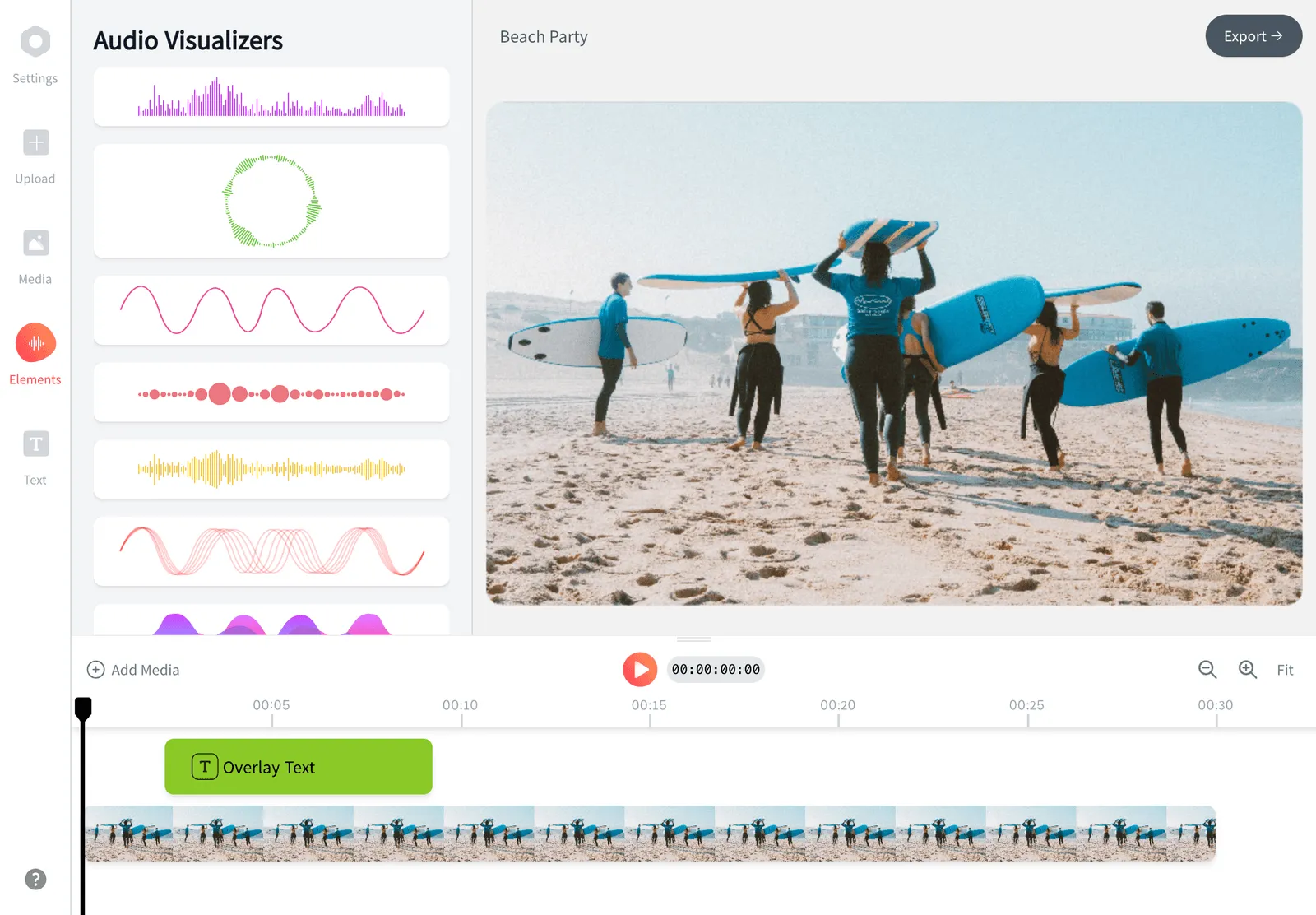
You do not need a camera to publish on YouTube or to post clips on TikTok, Instagram, and Facebook. Turn audio-only episodes into waveform videos with EchoWave's audio waveform video generator, or build a full clip with captions and your cover art in the online video editor. Captioned clips are what make a sponsor package easy to sell, because they show the show is alive and shareable.
11. Licensing, syndication, and archives
Some podcasts produce material that can be reused: interviews, original reporting, research, local history, educational lessons, or story archives. These assets can be licensed to newsletters, publications, training programs, schools, or media companies. Narrative and research shows have even been adapted into books and TV.
This model needs clear rights management. Keep guest releases, music licenses, transcript permissions, and production notes organized from day one, because a licensing deal lives or dies on whether you actually own what you are selling.
A practical monetization plan by show size
The biggest mistake is chasing ads before you have the downloads to make them pay. Match the model to your stage:
| Stage | Focus | Best revenue bets |
|---|---|---|
| 0 to 1,000 downloads per episode | Prove the audience and offer | Services, affiliates, templates, tip jar, email list |
| 1,000 to 5,000 | Package trust | Niche sponsors, workshops, memberships |
| 5,000 to 20,000 | Build repeatable inventory | Host-read sponsorships, paid feed, video clips, newsletter |
| 20,000 to 100,000 | Scale and diversify | Direct ads, programmatic ads, events, products |
| 100,000+ | Maximize and protect | Multiple ad slots, network deals, premium products, YouTube |
The podcast monetization checklist
- Define the listener and exactly why they trust you.
- Track downloads, retention, email signups, and social clip performance.
- Build a simple media kit with audience data and package options.
- Add one clear call to action to every episode.
- Repurpose each episode into at least three promotional assets.
- Test small paid offers before building large products.
- Keep sponsor reads honest, relevant, and disclosed.
How long until a podcast makes money?
Most shows that monetize on purpose see first revenue within their first year, and around 55% of creators report earning something in year one. But the path matters. If you wait for ad-network thresholds you may earn nothing for a long time. If you start with affiliates, a small paid offer, or services, you can earn from a few hundred listeners. Roughly 99% of podcasts never turn a real profit and many quit before episode 10, almost always because they chase scale instead of selling something specific to the people already listening.
Where to start
If your audience is small, start with offers that do not require huge downloads: consulting, affiliates, templates, workshops, or a paid community. If your audience is growing, package the show for sponsors and create video assets that make the value easy to see.
The strongest podcast businesses are not built from one revenue stream. They are built from trust, consistency, and useful content that can be packaged in more than one way. So the real answer to how podcasts make money is: they turn an engaged audience into several small, honest income streams, and they make each episode work harder by repurposing it everywhere their listeners already are.
Turn every episode into more monetizable assets
A podcast earns more when one recording becomes many assets: a full episode, short clips, captioned social videos, newsletter snippets, sponsor reads, and a searchable transcript. EchoWave turns your audio into video clips and waveform videos that support sponsorship packages, paid communities, and social growth, free and in your browser.
What people are saying about EchoWave
Small audience? Sell, do not wait for ads
Sources & further reading
- Spotify Partner Program, Spotify for Creators
- FTC's Endorsement Guides: What People Are Asking, Federal Trade Commission
- Podcast Measurement Technical Guidelines, IAB Tech Lab

About the EchoWave team
EchoWave is a browser-based video and audio editor built by Lemon Vault LLC since 2018. The people who build the editor write these guides and test every step in the production app before publishing.
Frequently Asked Questions
How many listeners do you need to make money from a podcast?
It depends on the model. Brand sponsorships usually want 1,000 to 5,000 downloads per episode to be worth pitching, and ad networks pay best at 5,000 plus. But affiliates, services, a small product, or a paid community can earn from a few hundred engaged listeners, because they pay on conversions rather than raw downloads.
How much do podcasts make per 1,000 downloads?
That is the CPM, the cost per thousand. Host-read ads typically pay about $15 to $20 for pre-roll and post-roll and $20 to $30 for mid-roll, with high-value niches like finance and B2B reaching $30 or more. So a single mid-roll on a 5,000-download episode at $25 CPM earns roughly $125.
How do free podcasts make money?
Free podcasts make money indirectly: host-read sponsorships and programmatic ads, affiliate commissions, listener memberships or subscriptions, merch, live events, and by selling the host's own services, courses, or products. The episode is free, but it builds the audience and trust that those streams convert.
Do podcasters get paid per listen or per view?
Not directly on most platforms. Audio ads pay on a CPM basis per thousand downloads or impressions, not per individual listen. On YouTube you earn from video ad views, roughly $3,000 to $5,000 per million views. Spotify's Partner Program pays eligible creators from ads and Premium video engagement.
How much money do podcasts make on Spotify?
Through the Spotify Partner Program, eligible shows earn from ads and Premium video views. Spotify has reported paying creators over $100 million in a single quarter, and hundreds of shows now pass $10,000 a month. To qualify you need at least 3 published episodes, 1,000 unique listeners, and 2,000 listening hours in the last 30 days.
What is a good CPM for podcast ads?
CPM is the rate an advertiser pays per thousand downloads. A healthy host-read average is about $20 to $25, with mid-roll commanding the most and niche, high-intent audiences like finance, technology, and B2B reaching $30 or higher. Programmatic ads usually pay less than direct host-read deals.
How long does it take for a podcast to make money?
Many creators see first revenue within their first year, and about 55% report earning something in year one. The fastest path for a small show is affiliates, a small paid offer, or services, which can pay from a few hundred listeners. Waiting for ad-network thresholds can mean earning nothing for a long time.
Are podcasts actually profitable?
Most are not. The average podcast gets around 129 downloads per episode, only about 7% clear 5,000 downloads, and roughly 99% never turn a real profit. The shows that do make money usually monetize on purpose early, with several small streams aimed at a specific, engaged audience rather than chasing scale.
How do small podcasts make money?
Small podcasts make money by selling something specific to their listeners instead of waiting for ads. The best early streams are affiliate offers, your own services or consulting, templates and digital products, a tip jar, and a low-priced paid community. These convert on trust and intent, not download volume.
Do you need video to monetize a podcast?
No, audio-only podcasts earn through ads, memberships, affiliates, and services. But video helps a lot. Posting full episodes and short captioned clips on YouTube, TikTok, Instagram, and Facebook drives discovery and adds a YouTube ad stream. You can turn audio into waveform videos and clips with EchoWave without any camera footage.
How do you get sponsors for a podcast?
Build a simple media kit with your downloads, audience profile, and example ad placements, then pitch brands that genuinely fit your niche. You can also list inventory on marketplaces like Podbean, Acast, RedCircle, or Spreaker. Relevant, host-read placements with clear disclosure perform best and renew.
Which podcast niches make the most money?
High-CPM, high-intent niches earn the most per listener: business and entrepreneurship, personal finance and investing, technology and software, health and fitness, and self-improvement. These audiences are valuable to advertisers and also buy courses, services, and memberships, so they monetize well at smaller sizes.
Turn your episodes into video that sells Free, in your browser
Create waveform videos, captioned clips, and audiograms from your podcast to grow your audience and build sponsor-ready assets. No credit card required, free plan includes a small Echowave.io watermark.
Get Started →