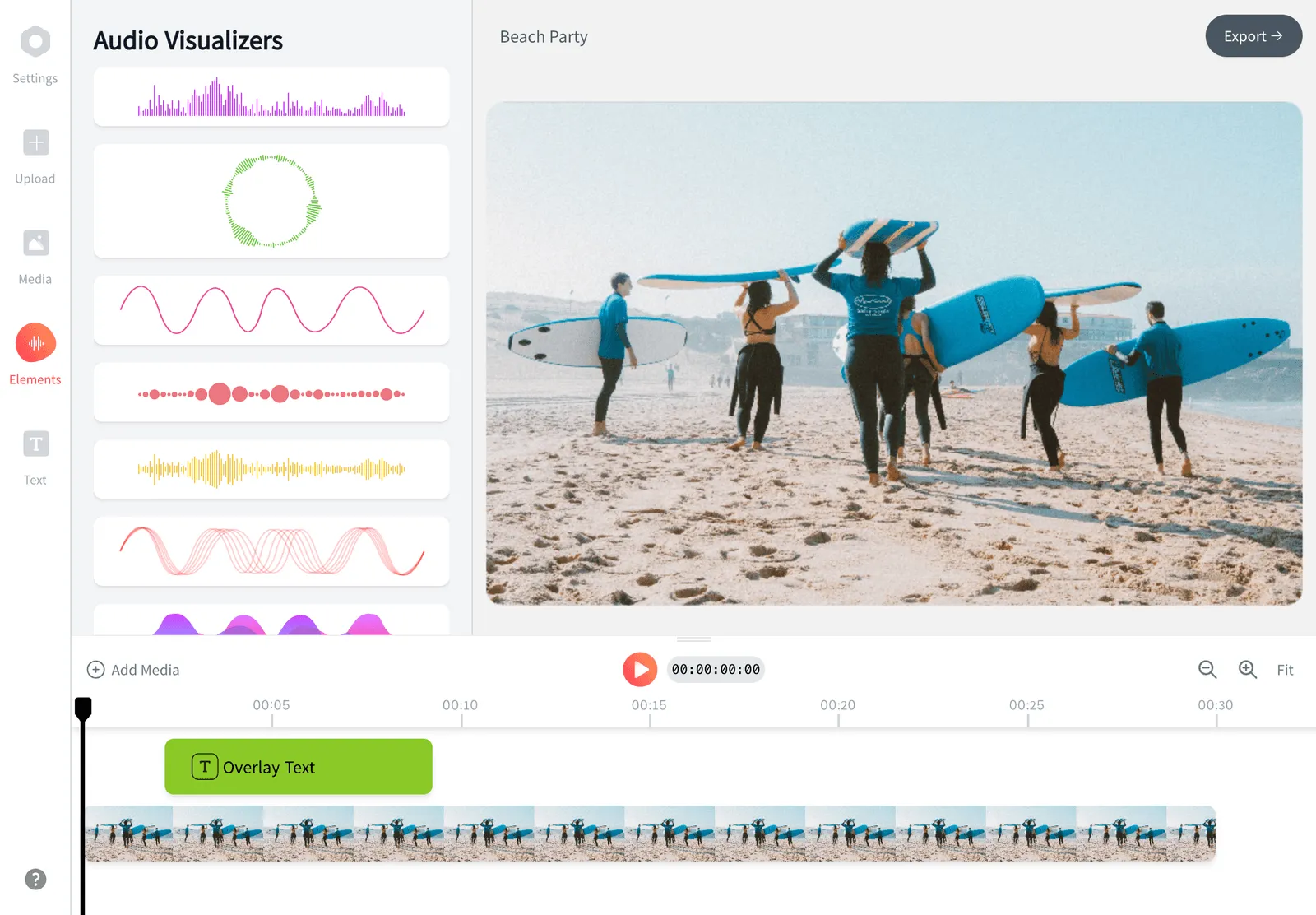
Add Audio to Video Online Free
Drop a music track, a voiceover or sound effects onto your clip, slide it into place, mix the volume, and export a finished MP4. It runs in your browser, so there is nothing to install.


Add Audio to Video Online Free Features
Echowave is used by thousands of businesses around the world





To add audio to a video, open the EchoWave editor, upload your video clip, then upload an audio file such as an MP3 or WAV and drop it onto the timeline. Drag the track to line it up with the picture, set the volume, add a fade if you want one, and export the finished video as an MP4. The whole process happens in your browser, free, with no account required to start, and it is the same workflow whether you add music to a video, add sound to a video, or layer a voiceover on top.
What you can add to your video
Audio is rarely one single thing, and the editor treats every sound as its own layer so you can stack as many as a project needs. The common jobs people bring here are:
- Background music: add background music to a video to set the mood for a vlog, ad, reel or slideshow. Drop a song under the picture and lower its volume so it sits behind speech rather than fighting it.
- Voiceover and narration: lay a recorded voice track over b-roll or screen recordings for tutorials, explainers and product demos. See the voiceover tool for a recorder built into the timeline.
- Sound effects: add sound effects to a video, short whooshes, clicks, pops and stingers, placed at exact moments to punctuate cuts and on-screen actions.
- Replacement audio: mute the clip's original sound and swap in a cleaner recording, a translated track or a fresh music bed. The remove audio tool strips the existing track first if you want a silent base to build on.
Each layer keeps its own volume control and timing, so a quiet music bed can run the full length while a narration and a few effects sit on top exactly where they belong.
How to add audio to video without losing quality
A video file is a container (usually MP4 or MOV) that holds a video stream and one or more audio streams. When you add audio to video in EchoWave, you place a new audio layer on the timeline above the picture, set where it starts and how loud it is, and the editor mixes everything down into a single audio track when you export. The original picture is never re-cut unless you trim it, so quality stays intact.
Because the mix is rebuilt at export time, you can keep editing non-destructively. Move a track a second to the left, drop the music by a few decibels, add a two-second fade-out at the end, then preview the result before you commit. Nothing is baked in until you hit export, so there is no penalty for experimenting.
The practical controls you will reach for most:
- Volume and balance: set each layer independently so music ducks under a voice instead of drowning it. A music bed at roughly 15 to 25 percent under clear speech is a safe starting point.
- Trim and split: cut an audio clip to length, or split it to drop a different section under a particular scene.
- Fade in and fade out: a short fade at the start and end stops audio from beginning and ending with an abrupt click, which is the single biggest giveaway of a rushed edit.
- Loop: repeat a short track to cover a longer video when your music is shorter than the footage.
- Mute the original: silence the camera audio entirely when you are replacing it, or keep it and tuck the music underneath.
Supported audio and video formats
You can upload the formats people actually have on hand. On the audio side that means MP3, WAV, M4A, AAC, OGG, FLAC and AIFF. On the video side the editor accepts MP4, MOV, WebM, MKV, AVI and M4V, along with most other common containers.
That covers the common case of adding an MP3 audio track to an MP4 video, as well as less obvious pairings. Exports are delivered as MP4 with H.264 video and AAC audio, the combination that plays on practically every phone, browser, TV and social platform without re-encoding on the other end. MP4 is what TikTok, Instagram, YouTube, Facebook and LinkedIn all prefer, so the file you download is ready to upload as is.
If your source file uses an unusual codec that your browser cannot decode for preview, the upload and the final render still go through, because the heavy lifting is done server-side rather than relying solely on the browser. In day-to-day use the formats above cover almost everything that comes off a phone, camera, screen recorder or download.
Tips for music, voiceovers and sound effects
Whether you add music to video or add sound to video, good audio is mostly about levels and timing rather than fancy effects. A few habits make a clear difference:
- Mix for the voice. If there is narration, it is the priority. Set speech to a comfortable, consistent level first, then bring music up underneath until you can still hear every word easily.
- Match the cut. Line up musical beats or sound effects with your edits. A transition that lands on the beat feels deliberate; one that drifts feels loose.
- Top and tail with fades. A half-second fade-in and a one to two second fade-out at the end of the video keeps the soundtrack from cutting off mid-note.
- Leave headroom. Avoid pushing levels into distortion. If the meter is constantly maxed out, pull everything down a touch; quiet-but-clean beats loud-but-clipped every time.
- Keep stereo intent. Music and effects usually sit better in stereo, while a mono voice recording centres cleanly in the mix.
Copyright and royalty-free music
If your video is going anywhere public, the music matters as much as the edit. Popular commercial songs are protected, and platforms like YouTube, Instagram and TikTok run automated content matching that can mute your audio, block the upload, demonetise it or flag your account. That risk applies whether or not the video makes money.
To add music to a video without copyright trouble, stick to music you are licensed to use: royalty-free or Creative Commons tracks, library music you have a license for, or audio you recorded yourself. EchoWave does not host a stock music catalogue, so bring your own file. Plenty of creators keep a small folder of cleared tracks from royalty-free libraries and reuse them across projects. For voice and original sound there is no clearance issue at all, which is part of why a recorded voiceover is such a dependable choice.
Platform specs worth matching
Adding audio is often the last step before posting, so it helps to export in the shape each platform wants:
- TikTok, Reels and Shorts: vertical 9:16, MP4, AAC audio. Short-form thrives on a strong music or voice hook in the first second.
- YouTube (standard): horizontal 16:9, MP4. Music beds usually sit lower here because viewers expect dialogue to lead.
- Instagram feed and Facebook: square 1:1 or 4:5 works well, MP4 with AAC audio so the sound plays correctly inline.
- Podcasts turned into video: pair a static image or waveform with your episode audio. The MP3 to YouTube tool and the music visualizer are built for exactly that.
Keeping audio as AAC inside an MP4 avoids the silent-video problem some platforms have with less common codecs, where the picture plays but the sound is dropped.
Privacy, devices and browsers
Because you add audio to video online, in the browser, it works the same on Windows, macOS, ChromeOS, Linux, and on iPhone and Android. You can add music to a video on iPhone or Android straight from the phone's browser with no app to install and no plugin to enable. Use a recent version of Chrome, Edge, Firefox or Safari and you are set.
Your files are only sent to EchoWave's processing servers to build the final export, then handled according to the privacy policy; they are not posted or shared anywhere on your behalf. EchoWave is free to use. The free plan adds a small EchoWave watermark to exports from the full editor, which a paid plan removes. If you only need a quick crop, trim, compress or convert, EchoWave's dedicated quick tools export with no watermark.
How to add audio to a video
Combine an audio track with your video in three steps, free and in your browser.
-
1. Upload your video and audio
Open the editor and add your video clip, then upload an audio file (MP3, WAV, M4A and more) onto the timeline.

-
2. Sync and mix the audio
Drag the track to line it up with the picture, set the volume so music sits under any speech, and add fades or a loop.

-
3. Export your video
Preview the result, then export a finished MP4 ready to upload to TikTok, YouTube, Instagram or anywhere else.
How creators use EchoWave in real projects

About the EchoWave team
EchoWave is a browser-based video and audio editor built by Lemon Vault LLC since 2018. The people who build the editor write these guides and test every step in the production app before publishing.
Frequently Asked Questions
How do I add audio to a video for free?
Open the EchoWave editor, upload your video, then upload an audio file and drop it onto the timeline. Line it up, set the volume, and export an MP4. It is free and runs in your browser with no account needed to start.
How do I add background music to a video?
Add your music track as a new layer below the picture, then lower its volume to roughly 15 to 25 percent so it sits behind any speech. Add a short fade-in at the start and a fade-out at the end for a clean finish.
Can I add more than one audio track at a time?
Yes. Each sound is its own layer, so you can run a music bed, a voiceover and several sound effects together. Every layer keeps its own volume and timing, and they are mixed into one track when you export.
How do I replace or change the audio in a video?
Mute the clip's original audio (or remove it first with the remove audio tool), then upload the new track and place it on the timeline. The new audio plays in place of the old.
What audio and video formats are supported?
You can upload MP3, WAV, M4A, AAC, OGG, FLAC and AIFF audio, plus MP4, MOV, WebM, MKV, AVI and M4V video. Exports come out as MP4 with H.264 video and AAC audio for wide compatibility.
How do I sync the audio with the video?
Drag the audio layer left or right on the timeline until it lines up with the picture, then preview to check. You can split the track to position a section under a specific scene or trim it to fit exactly.
How do I add music to a video without copyright issues?
To add music to a video without copyright issues, use music you are licensed to use, such as royalty-free or Creative Commons tracks, library music with a license, or audio you recorded yourself. Popular commercial songs can trigger content matching that mutes, blocks or demonetises your upload.
How do I add music to a video on iPhone or Android?
Open EchoWave in your phone's browser, upload the video and audio from your device, place the track on the timeline, then export. It works on iPhone and Android without installing an app.
How do I add sound or sound effects to a video?
Adding sound works just like adding music: upload your sound file or sound effect, drop it on the timeline, then slide it to the exact frame you want it to hit. You can stack several sound effects over a clip and set each one's volume independently.
My music is shorter than the video. What can I do?
Loop the audio track so it repeats and covers the full length, or trim a longer section to fit. Add a fade-out at the very end so the loop does not cut off abruptly.
Will adding audio reduce my video quality?
No. Adding an audio layer does not re-cut the picture, so the video stream stays as it was. Only the audio is remixed at export, which keeps the visuals at full quality.
Does the exported video have a watermark?
The free plan in the full editor adds a small, removable EchoWave watermark, which a paid plan removes. EchoWave's dedicated quick tools for crop, trim, compress and convert export with no watermark.
Can I add a voiceover instead of music?
Yes. Record or upload a voice track and place it over your footage, then keep music underneath at a low volume. The voiceover tool includes a recorder built right into the timeline.
Ready to add audio to a video?
No credit card required, our free plan includes a small Echowave.io watermark.
Get Started →