How to Create a Podcast Graphic That Stands Out
A podcast graphic has one job before anything else: make the right listener understand your show in about one second, at the size of a postage stamp. It does not need to explain the whole brand. It needs to be recognizable, legible, and true to the promise of the show, whether it shows up as cover art in a directory, a thumbnail in a feed, or the still frame on a video clip.
This guide covers the exact sizes and specs every platform wants in 2026, the design rules that actually move clicks, how to build a reusable podcast graphics system, and how to turn that artwork into video so your show travels past the podcast apps. Every method here is doable in your browser, and most of it is free.
Quick answer: what makes a strong podcast graphic
A strong podcast graphic is:
- Square (1:1) for show cover art
- 3000 x 3000 px as the master file, exported to platform sizes
- High contrast so it reads at thumbnail size
- Five to seven words or fewer of text, usually just the show title
- Built on a limited color palette so it has one memorable signal
- Topic-clear, so a stranger knows what the show is about
- Reusable across episode thumbnails, social clips, audiograms, and media kits
If you only remember one rule: design for the thumbnail, not the billboard. Roughly 70 percent of podcast listening happens on a phone, where your art is displayed tiny. A cover that wins at 3000 px but disappears at 55 px is a cover that loses.
Podcast graphic sizes and specs (2026)
Every directory pulls your cover art from the same image in your podcast host's RSS feed, then displays it at its own sizes. So you design one master file and let each platform scale it down. Build at the largest spec, which is 3000 x 3000 pixels, square, RGB, at 72 dpi.
Here are the current requirements for the major platforms.
| Platform | Pixel range | Recommended | Formats | Color | Aspect |
|---|---|---|---|---|---|
| Apple Podcasts | 1400 x 1400 min to 3000 x 3000 max | 3000 x 3000 | JPG, PNG | RGB | 1:1 |
| Spotify | 640 x 640 to 10000 x 10000 | 3000 x 3000 | JPG, PNG, TIFF | sRGB | 1:1 |
| YouTube (podcast / channel) | 1280 x 1280 | 3000 x 3000 source | JPG, PNG, GIF | RGB | 1:1 |
| Amazon / iHeart / others | Read from RSS feed | 3000 x 3000 | JPG, PNG | RGB | 1:1 |
A few specs people miss:
- No transparency. Apple Podcasts rejects PNGs with an alpha channel. Flatten the image onto a solid background before export.
- Keep the file under about 500 KB. Large covers slow RSS parsing and can fail to refresh in some apps. Export JPG at roughly 80 percent quality to stay small without visible artifacts.
- RGB, not CMYK. CMYK files (a print color mode) can be refused or render with shifted colors on screen.
- Square only. A 16:9 image or a logo with padding gets cropped or letterboxed in player rows.
Different platforms publish slightly different ranges and occasionally update them. Design the high-quality 3000 x 3000 master, then export platform-specific versions when a service asks for something narrower. Always confirm the current numbers on Apple Podcasts Connect and Spotify for Podcasters before you upload final artwork.
The thumbnail test: three sizes that decide everything
Before you judge a podcast graphic at full size, shrink it down and ask whether it still works. Your cover has to clear three checkpoints, and most weak designs fail the first one.
- About 100 x 100 px: Can a stranger tell what the show is about and read the title? This is the size in a phone search row and a "recommended" carousel. If the answer is no, simplify before you do anything else.
- About 300 x 300 px: Does it earn a tap in a directory listing? At this size your contrast pair and one main visual idea need to pull the eye.
- Full size in a player: Does it still look intentional and on-brand on a tablet, a 4K monitor, or a car dashboard? Detail can live here, but it should reward the listener rather than carry the message.
A quick way to test: export a 60 x 60 px copy and look at it next to the covers already on the Apple Podcasts or Spotify charts in your genre. If yours blurs into the grid, push contrast and cut text.
A cover that passes the thumbnail test usually has one main visual idea, one readable title, one dominant contrast pair, minimal small text, and clear separation between subject and background.
Pick a creative direction that fits your show
The biggest mistake in podcast graphics is decorating before deciding what the art is supposed to say. Start from the show's draw, then choose the direction.
Personality-led show
Use the host's face if the host is the reason people listen. Make eye contact strong, keep the background simple, and choose typography that matches the host's energy. Shows like The Joe Rogan Experience lead with the host because the host is the brand.
Expert or business show
Lead with the topic and credibility. Use clean sans-serif type, a consistent two-color or three-color system, and skip gimmicks that make the show look less serious than the content. Minimalist, geometric layouts read as authoritative.
Narrative, true crime, or story show
Use mood and atmosphere, but keep the title readable. Moody textures (maps, paper, single objects), heavier stencil or condensed fonts, and muted palettes with one sharp accent work well. A single strong object, like a gavel for a courtroom show, can carry the whole cover.
Comedy or pop culture show
You can be louder. Bolder colors, character illustration, exaggerated expressions, or a visual joke all fit, as long as the title is still legible at thumbnail size. Bright, high-saturation palettes and rounded fonts signal fun.
Branded show
If the podcast extends an existing brand, inherit that brand's fonts, colors, and logo treatment so the show looks like part of the family. Consistency is the point.
Typography rules that survive shrinking
- Use one or two font families, no more.
- Avoid thin or hairline weights, they vanish at thumbnail size. Favor medium to bold sans-serifs.
- Keep text to five to seven words, ideally just the show title. Drop taglines and "a podcast about" subtitles.
- Keep letter spacing normal, do not crush or stretch type to fit.
- Leave 10 to 12 percent margins so nothing gets cropped, and keep important text out of the bottom fifth where player controls and "explicit" tags can sit.
- Check contrast against both light and dark app interfaces, since many users browse in dark mode.
- Do not place text over a detailed face or busy background. Add a subtle overlay or shadow if you must.
Color and contrast
Most podcast apps show dozens of covers in one grid, so contrast is what gets you noticed. Choose a palette that gives one memorable signal.
A simple palette formula:
- One dominant background color
- One strong text color with high contrast against it
- One accent color
- One neutral
Warm colors (red, orange, yellow) read as energetic and bold. Cool colors (blue, green, purple) read as calm, trustworthy, and considered. Pick by mood, then commit. Avoid a wall of similar mid-tones, if everything is medium brightness, nothing stands out. Use a tool like Coolors to lock a palette, then reuse those exact hex values across every graphic the show produces.
How to make a podcast graphic step by step
You do not need design software or a budget to make a strong cover. Here is the fastest reliable path.
- Set the canvas to 3000 x 3000 px, RGB, 72 dpi. Open Canva, Adobe Express, Photopea, or Figma and start a square document. Free tiers cover everything below.
- Choose your direction from the section above, then sketch one main visual idea. Resist adding a second.
- Place the title in three to five words using one bold, legible font. Position it in the negative space of your image, not across the busiest part.
- Apply your four-color palette. Background, text, accent, neutral. Check the contrast between text and background.
- Run the thumbnail test. Drop the canvas to 100 x 100, then 55 x 55. Fix anything that disappears.
- Check dark mode and margins. Preview on a dark background and confirm nothing important sits in the outer 10 percent.
- Export two files. A 3000 x 3000 PNG master with no transparency, and a JPG under 500 KB for upload. Keep the layered source file so you can spin off episode graphics later.
Build a podcast graphics system, not one square
Your show cover is only the first podcast graphic you need. The shows that look professional everywhere build a small visual system from the same fonts, colors, and logo, then reuse it.
| Asset | Where it appears | Typical size |
|---|---|---|
| Show cover | Apple, Spotify, your website | 3000 x 3000 (1:1) |
| Episode thumbnail | YouTube, Spotify video, episode page | 1280 x 720 (16:9) |
| Audiogram frame | Audio clips on social | 1080 x 1080 (1:1) or 1080 x 1920 (9:16) |
| Quote card | Social promotion | 1080 x 1080 |
| Guest announcement | Interview promotion | 1080 x 1080 or 1080 x 1350 |
| Media kit graphic | Sponsorship and press | Varies |
The most underused asset on that list is the audiogram. A still cover does not autoplay or grab attention in a scrolling feed, but a short video that pairs your cover art with an animated waveform and captions does. That is the bridge from a podcast app to social reach.
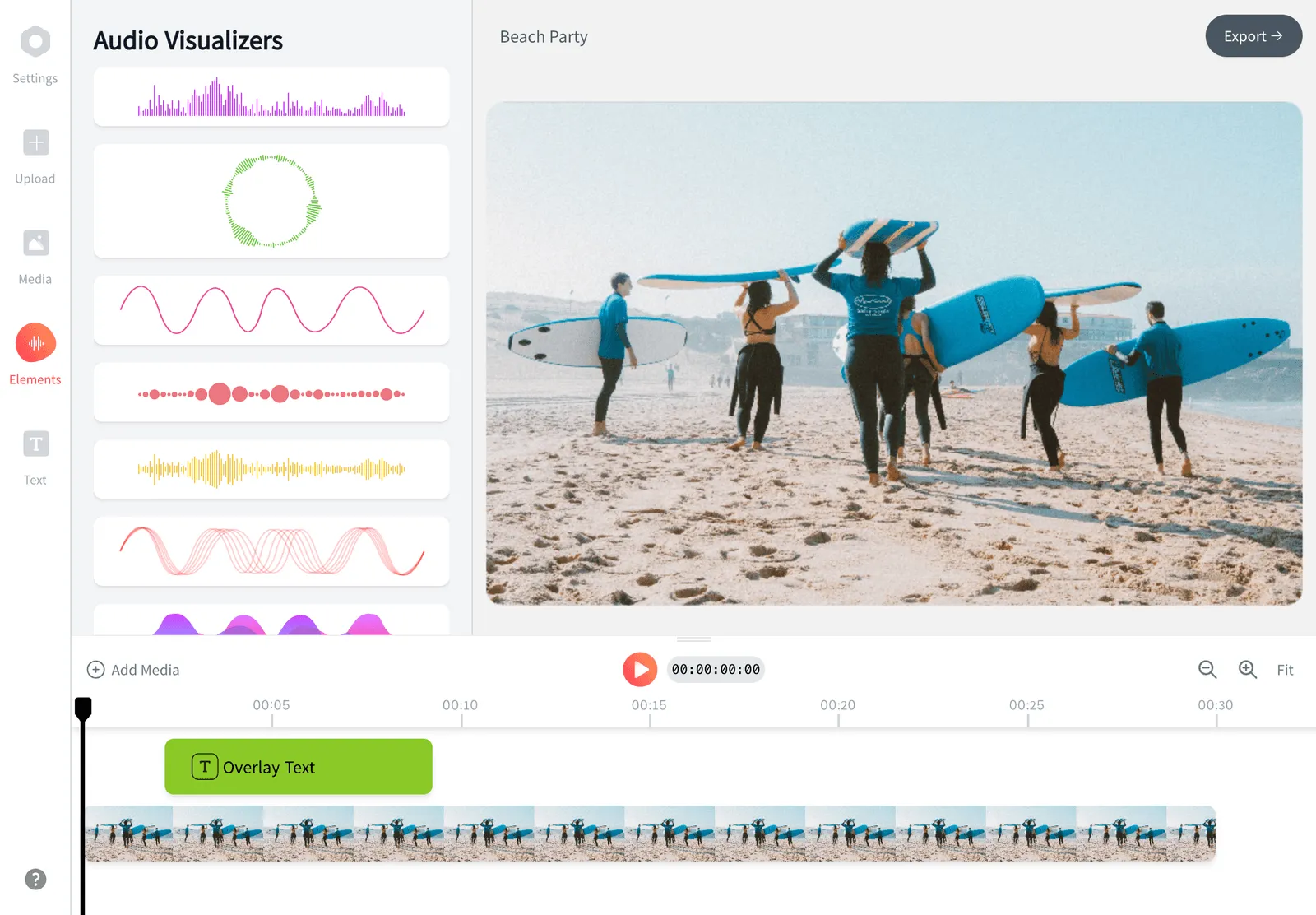
EchoWave turns your cover art and a clip of your episode into a shareable video right in your browser. Use the audio waveform video generator to animate the sound, the add image to MP3 tool to drop your cover behind the audio, or the full video editor to add captions, a title, and your logo. There is also a dedicated podcast to video tool for turning whole episodes into watchable, postable clips.
Design for thumbnails before billboards
Podcast art is usually seen small: in a podcast app row, a social card, or a video thumbnail. Test the design at tiny sizes before you celebrate the full-resolution version, and turn the same artwork into an animated clip so it stops the scroll in a feed.
What people are saying about EchoWave
Turn your podcast graphic into a video clip
Free tools to make a podcast graphic
You do not need to hire a designer to ship a good cover, though you can. Here is how the common options compare.
| Option | Best for | Cost | Time | Watch out for |
|---|---|---|---|---|
| Canva / Adobe Express | DIY with templates and reusable assets | Free to about $20/mo | 1 to 3 hours | Template designs can look generic, tweak them |
| Photopea / Figma | Free, more control, layered files | Free | 2 to 4 hours | Steeper learning curve |
| AI cover generators | Fast first drafts and inspiration | $0 to $30 | 15 to 30 min | Check usage rights, never prompt for trademarked or real-person likenesses |
| Freelance designer (Fiverr, 99designs) | Budget custom work | $65 to $500 | a few days to 2 weeks | Quality varies, review a portfolio first |
| Studio or agency | Premium, full brand systems | $500 to $2,000+ | 1 to 4 weeks | Overkill for a first episode |
For free fonts, use Google Fonts (commercially usable). For palettes, use Coolors. For stock imagery, use only photos you have licensed, then customize so the cover is unmistakably yours. Whatever you build, you can take the finished artwork into EchoWave to make matching episode clips and audiograms.
Common mistakes to avoid
- Microphone-and-headphones clichés. They say "podcast" but nothing about your show. Show the topic instead.
- Tiny or thin text that evaporates at thumbnail size.
- Too many words. A long subtitle is unreadable in a player row.
- Low contrast, especially mid-tone text on a mid-tone background.
- Transparency or CMYK that gets the file rejected by Apple.
- Ignoring dark mode, so a light cover with white text disappears.
- A one-off design with no system, so every clip and guest card looks like a different show.
- Borrowed or unlicensed assets, including fonts and stock photos you do not have rights to.
Podcast graphic checklist
- Can a stranger read the title in two seconds at 100 x 100 px?
- Does the art still work at 55 x 55 px thumbnail size?
- Is the topic or personality obvious without the title?
- Is the artwork original or properly licensed, including fonts?
- Is the file square, 3000 x 3000, RGB, with no transparency, under 500 KB?
- Does it work on both dark and light app backgrounds?
- Can it be adapted into social clips, audiograms, and episode pages?
- Does it avoid misleading platform logos, badges, or claims?
Design the podcast graphic as a system, starting with the cover, then build reusable templates for clips, quotes, guest announcements, and sponsorship decks. That consistency is what makes a show easy to recognize everywhere it appears.
Sources & further reading
- Show Cover artwork requirements, Apple Podcasts for Creators
- The dos and don'ts of show art, Spotify for Creators
- Add video thumbnails, YouTube Help

About the EchoWave team
EchoWave is a browser-based video and audio editor built by Lemon Vault LLC since 2018. The people who build the editor write these guides and test every step in the production app before publishing.
Podcast graphic FAQ
What size should a podcast graphic be?
Design a square master file at 3000 x 3000 pixels in RGB at 72 dpi. Apple Podcasts accepts 1400 x 1400 up to 3000 x 3000, and Spotify accepts 640 x 640 up to 10000 x 10000, so a 3000 x 3000 file satisfies every directory while staying crisp on large screens.
What format should podcast cover art be?
Use JPG or PNG, both accepted everywhere (Spotify also takes TIFF). The image must be RGB, square, and flattened with no transparency, since Apple Podcasts rejects PNGs that contain an alpha channel. Keep the file under about 500 KB by exporting JPG at roughly 80 percent quality.
How do I make a podcast graphic for free?
Open a free tool like Canva, Adobe Express, or Photopea, start a 3000 x 3000 square canvas, add one main visual and a three to five word title in a bold font, apply a four-color palette, then export a JPG under 500 KB. Use Google Fonts for free type and only licensed or original imagery.
How many words should be on a podcast cover?
Five to seven words at most, and usually just the show title. Long subtitles and taglines become unreadable at thumbnail size, where most listeners first see your cover. Let the imagery carry the topic and keep the text to the name.
Should a podcast graphic include the host's photo?
Only if the host is the main draw, as with a personality-led or interview show. Make eye contact strong and keep the background clean. For topic-driven shows, lead with imagery that signals the subject instead, since a generic headshot rarely communicates what the show is about.
Can I change my podcast cover art after publishing?
Yes. Upload the new artwork to your podcast host, not directly to each platform, and the change propagates through your RSS feed. Most directories refresh within 24 to 48 hours. Using a new filename can speed up how quickly apps pick up the update.
What is the difference between podcast cover art and a podcast graphic?
Cover art is the single square image directories show for the whole podcast. A podcast graphic is any visual the show uses, including the cover, episode thumbnails, audiograms, quote cards, and guest announcements. The best shows derive all of them from one consistent system of fonts, colors, and logo.
What size is a podcast episode thumbnail for YouTube?
Use 1280 x 720 pixels at a 16:9 aspect ratio for a YouTube video thumbnail, with a minimum width of 640 pixels. That is different from the square 1:1 cover art directories use, so build a separate 16:9 template for episode thumbnails rather than cropping the cover.
How do I turn my podcast graphic into a video?
Pair the cover art with an animated waveform and captions, then export an MP4. In EchoWave you upload a clip of your episode, add your cover image and an animated waveform, add a title or captions, and export a square or vertical video ready for social. It plays in the feed and autoplays as people scroll, which reaches far more people than a still image.
How much does podcast cover art cost?
Free if you design it yourself in Canva or Adobe Express. A freelance designer typically runs $65 to $500, and a studio or agency that builds a full brand system can run $500 to $2,000 or more. For a first show, a careful DIY cover that passes the thumbnail test is usually enough.
Why does my podcast cover look bad at thumbnail size?
Almost always too much text, thin fonts, or low contrast. Cut the words to the show title, switch to a bold weight, and increase the difference between the text color and the background. Test the file at 55 x 55 pixels next to other covers in your genre before you publish.
Do I need different graphics for each platform?
No. One square 3000 x 3000 master serves Apple, Spotify, and most directories, which scale it down automatically. You only need extra files for off-square uses, such as 16:9 YouTube thumbnails and 9:16 vertical clips for social video.
Turn your podcast graphic into video Free, in your browser
Pair your cover art with an animated waveform and captions to make scroll-stopping clips for social. No credit card required, and the free plan adds a small Echowave.io watermark.
Get Started →