OGG to MP3 Converter

Turn an OGG that your car stereo or old player ignores into an MP3 that plays on practically anything. Free, in your browser, no signup.

CTA Hero Icon
Hero - null
Rated 4.5 / 5 on

OGG to MP3 Converter Features

EchoWave is used by creators, marketers, educators, and businesses to convert and edit media online.

Google Logo
Dolby Logo
Teacherly Logo
Mashable Logo
BBC Logo
Updated June 2026

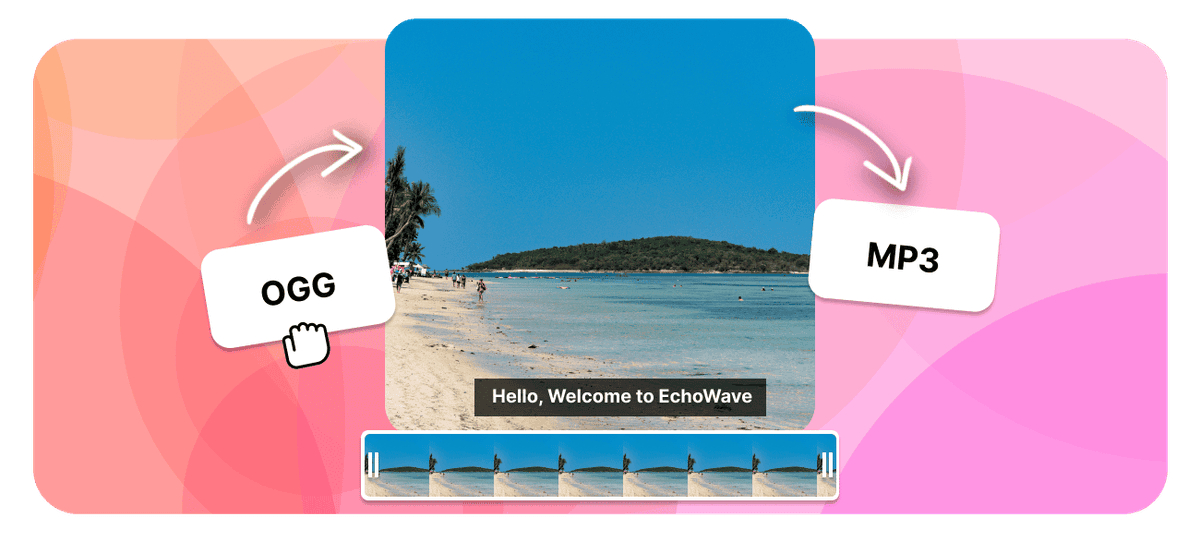
OGG plays well on Android, Firefox, and VLC, but car stereos, USB sticks, older phones, and plenty of music apps still ignore it. MP3 is the one audio format that plays almost everywhere, which is why it is the safe choice when you just need a file to work. EchoWave converts OGG to MP3 free in your browser, with no signup and no watermark, at the bitrate you pick.

Free, no sign-upNo account, no trial
Runs in your browserNothing to install
Works on every devicePhone, tablet, laptop
No watermarkClean output, every time

How it works

How to convert OGG to MP3

  1. 1

    Upload your OGG

    Drag your OGG onto the converter or pick it from your device. Nothing to install.

  2. 2

    Choose MP3 and convert

    Select MP3 as the output, set the bitrate if it applies, then start. Free, with no sign-up.

  3. 3

    Download your MP3

    Save the finished MP3, or open it in the editor to trim or adjust it first.

Try it

Estimate your MP3

Pick a bitrate and a length to see the MP3 file size before you convert.

Bitrate
10 min
1 min60 min

Drag to set the clip length in minutes, from 1 to 60.

Estimated MP3 size14MBGreat for most music

An estimate. Real size varies a little with the encoder and the audio itself.

The formats

OGG vs MP3

OGG

Ogg Vorbis

Open, royalty-free lossy audio

Type
Lossy audio (Vorbis)
Holds
Vorbis audio in an Ogg container
Typical size
Small at good quality
Plays on
Android, Firefox, Chrome, and VLC

Best for:Open audio for games and the web

MP3

MPEG-1 Audio Layer III

The most universal audio format ever made

Type
Lossy audio format
Holds
Audio only
Typical size
Small, about 1 MB per minute at 128 kbps
Plays on
Effectively everything

Best for:Music, podcasts, and audio you listen to

Will it lose quality?

  • Converting a lossy file to a lossless one cannot restore detail that was already discarded. It only makes a larger file.
  • Going from a high-quality source to MP3 keeps the sound clear while changing the format.
  • Each pass between two lossy formats loses a little, so always convert from the best source you have.

Use cases

What people use it for

Music librariesStandardise your collection
ListenersUse a format your player likes
PodcastersMatch your host requirements
EditorsImport audio your tool accepts
DevicesPlay on phones and car stereos

Troubleshooting

If something looks off

The MP3 is larger than I expected
Lossless and uncompressed formats are big by design. If you want a smaller file, pick a lossy format and a bitrate around 192 to 256 kbps.
The song details are missing
Title, artist, and album travel as tags when the source has them. If they are blank, add them in any music app after converting.
My app will not open the MP3
Most apps open common audio, but a few are picky. VLC plays almost anything, or convert to MP3 for the widest support.

FAQ

OGG to MP3 questions

Why convert OGG to MP3?
MP3 is supported by effectively every device, app, car stereo, and player, while OGG support is patchy outside Android, Firefox, and VLC. If an OGG will not play somewhere, converting it to MP3 is the most reliable fix.
Is the OGG to MP3 converter free?
Yes. EchoWave converts OGG to MP3 with no signup, no file-count limit, no trial, and no watermark. Upload the OGG, convert it, and download the MP3 from your browser.
How do I convert OGG to MP3?
Upload your OGG, choose MP3 as the output format, pick a bitrate, then start the conversion. When it finishes, download the MP3 or open it in the editor to trim it.
Does converting OGG to MP3 lose quality?
OGG Vorbis and MP3 are both lossy, so going from one to the other re-encodes audio that was already compressed and drops a little more detail. The loss is usually hard to hear at 192 kbps or above, and you should always convert from the best OGG you have rather than an already-shrunk copy.
What MP3 bitrate should I use?
Use 320 kbps for music you want to keep, 192 to 256 kbps for everyday listening, and 128 kbps for podcasts or voice notes. A bitrate higher than the OGG source will not add quality, it only makes a larger file.
Can I play the MP3 in my car or on a USB stick?
Yes. MP3 is the format almost every car stereo, head unit, and USB media player reads, which is one of the main reasons people convert OGG files. Copy the finished MP3 to a stick or your phone and it should play.
Will the track details carry over?
Title, artist, and album travel as ID3 tags when your OGG already includes them. If they come through blank, you can add or edit them in any music app after converting.
Does the OGG to MP3 converter work on iPhone, Android, Mac, and Windows?
It does. Plenty of OGG files start life on an Android phone or a Firefox download, and you can finish the job on any of them: the page loads in Safari on an iPhone or iPad, Chrome on Android, and any browser on a Mac, Windows PC, Chromebook, or Linux box. Once the MP3 lands in your downloads it opens just as easily in the stock player on each of those devices.
Can I convert several OGG files at the same speed?
There are no file-count limits on these pages, so you can convert your OGG files one after another. Each file uploads and converts on its own, and larger files take a little longer.

What people say after converting with EchoWave

Convert OGG to MP3 for free Free online converter

Upload an OGG and get a universal MP3 back. No signup, no file limits, no watermark, ready for any player.

Convert Files →