
MKV to MP4 Converter
Turn an MKV into an MP4 that plays on phones, browsers, and TVs. Often a lossless container swap. Free, in your browser, with no signup.


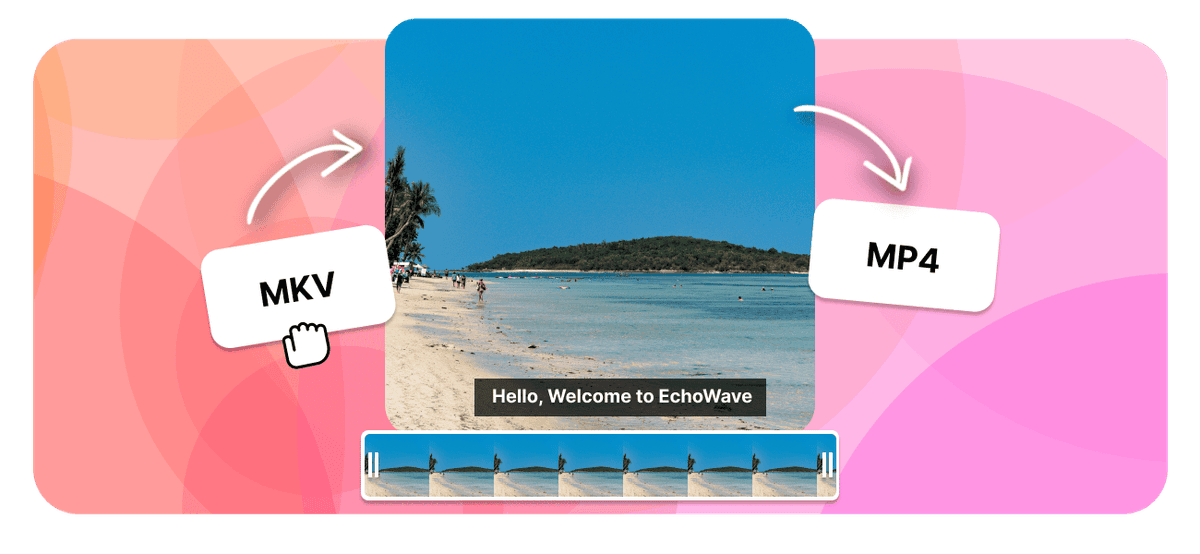
MKV to MP4 Converter Features
EchoWave is used by creators, marketers, educators, and businesses to convert and edit media online.





Convert an MKV to MP4 so it plays everywhere: phones, browsers, smart TVs, and almost any app or upload box. MKV holds the same video codecs MP4 does, so when the inside is already H.264 or H.265 the converter can repackage the streams into an MP4 container with no re-encoding and no quality loss. MP4 is the most widely supported video format there is, which is why it is the usual answer when an MKV will not open or upload. EchoWave does it in your browser, free and with no signup.
How it works
How to convert MKV to MP4
- 1
Upload your MKV
Drag your MKV onto the converter or pick it from your device. Nothing to install.
- 2
Choose MP4 and convert
Select MP4 as the output and start. Free, with no sign-up and no watermark.
- 3
Download your MP4
Save the finished MP4, or open it in the editor to trim, crop, or resize it first.
Try it
Estimate your MP4
Pick a video bitrate and a length to see the MP4 file size before you convert.
Drag to set the clip length in minutes, from 1 to 30.
An estimate. Real size varies with resolution, frame rate, and how much the picture moves.
The formats
MKV vs MP4
Matroska Video
An open container that holds almost anything
- Type
- Open video container
- Holds
- Almost any codec, plus several audio and subtitle tracks
- Typical size
- Large, depends on the codec inside
- Plays on
- VLC and most modern players, less on default phone apps
Best for:Movies with multiple audio tracks and subtitles
MPEG-4 Part 14
The video format that plays everywhere
- Type
- Video container
- Holds
- H.264 video plus AAC audio, sometimes subtitles
- Typical size
- Large, it carries video
- Plays on
- Phones, browsers, TVs, almost any player
Best for:Watching and sharing video
Will it lose quality?
- When the codecs already match MP4, the converter can change the container without re-encoding, so the picture stays identical.
- When the video has to be re-encoded for MP4, a high bitrate keeps it visually close to the MKV.
- Converting cannot add detail the MKV never had. The output is at best as good as the source.
Use cases
What people use it for
Troubleshooting
If something looks off
The MP4 will not play
The file got larger
Audio and video drift out of sync
FAQ
MKV to MP4 questions
Can MKV to MP4 be done without losing quality?
Why will my MKV not play but an MP4 would?
Is the MKV to MP4 converter free?
How do I convert MKV to MP4?
What happens to multiple audio tracks and subtitles?
Does the MKV to MP4 converter work on iPhone, Android, Mac, and Windows?
Can I convert a large MKV movie to MP4?
What is an MKV file?
What is the difference between MKV and MP4?
Can I convert MKV to MP4 without installing software or adding a watermark?
Will my MKV play on a smart TV, PlayStation, or Xbox after converting?
Does converting MKV to MP4 make the file smaller?
Can I convert several MKV files at once?
How long does converting MKV to MP4 take?
Is it safe to convert MKV to MP4 here?
Why convert MKV to MP4
MKV is the most capable video container in common use. It is open, it holds almost any codec, and it can carry a film with several audio languages, switchable subtitles, and chapter markers in a single tidy file. That is exactly why media libraries, Blu-ray rips, and downloads so often arrive as .mkv.
Its weakness is not technical, it is social. Because MKV is not tied to a standards body that device makers license from, plenty of hardware never bothered to support it. The video inside is almost always ordinary H.264 or H.265, which those devices decode perfectly well, but they refuse the wrapper it arrives in. MP4 is the wrapper they all agreed on.
So the usual reasons to convert are all about the destination rather than the file:
- A TV, console, or set-top box will not open it. Smart TVs and games consoles are notoriously uneven about MKV, and this is where the conversion earns its keep most often.
- A phone's gallery app ignores it. The video would play fine, but the default player will not touch the container.
- An upload box rejects it. Social platforms, learning management systems, and most web forms accept MP4 and little else.
- An editor will not import it. Plenty of editing software, especially the consumer end, expects MP4 or MOV.
- It needs to play in a browser. MP4 with H.264 is the format the web is built on.
The part that makes this conversion unusually painless: MKV and MP4 can hold exactly the same video and audio streams. When your MKV already contains H.264 or H.265, the converter can copy those streams straight into an MP4 container without decoding and re-encoding anything. That repackaging, often called a remux, is lossless and quick. Nothing about the picture changes, because nothing about the picture is touched.
The flip side is that the file will be about the same size afterwards. Moving the same data into a different box saves nothing, so a 4 GB MKV becomes a roughly 4 GB MP4. If the size is the actual problem, that is a job for the video compressor rather than a format change, and trimming the file down to the part you need cuts more weight than any setting.
What people say after converting with EchoWave
How to convert MKV to MP4 online
Four steps, no account, and no codec pack to install.
- Add your MKV. Drag the file onto the converter or pick it from your device. Large, feature-length files are normal here, since MKV is what people archive whole films in.
- Choose MP4 as the output format. That is the only setting the conversion needs.
- Start the conversion. The work runs on our servers rather than in your browser tab, so a Chromebook, an old laptop, or a phone handles a multi-gigabyte movie as well as a desktop would, and nothing fills up your local disk with temporary files.
- Download your MP4. No watermark, no sign-up screen, and no trial to cancel.
If the file needs more than a container change, open it in the video editor first to trim, crop, resize, or add captions before exporting.
About converting several files. There is no limit on how many you put through, but they go one after another rather than as a single batch upload, so a full season of episodes means repeating the steps for each one. For a whole library, a desktop tool with a batch queue will be less tedious than doing it in a browser.
What happens to subtitles and audio tracks
This is the one place MKV to MP4 genuinely costs you something, and it is worth understanding before you convert rather than after.
MKV was built to hold many tracks at once. MP4 was not. The main video and audio come across cleanly every time, and a single subtitle or audio track usually travels with them, but a stack of audio languages and embedded subtitles will not all survive the trip. If you depend on all of them, keep the MKV alongside your MP4 rather than replacing it.
Subtitles
How well subtitles carry over depends on what kind they are, and MKV can hold two very different kinds.
- Text subtitles (SRT, and the ASS or SSA formats used for styled and karaoke captions) are stored as characters with timings. MP4 has its own timed-text format, but player support for it is patchy: the same file may show subtitles in VLC and none at all on a phone or a TV. Styling from ASS and SSA is the first thing to go, since MP4's timed text has nothing like the same formatting.
- Bitmap subtitles (PGS from Blu-ray rips, VobSub from DVDs) are not text at all, they are little pictures of text overlaid on the frame. MP4 has no equivalent, so these cannot come across in any form.
If subtitles matter, there are two reliable routes. Keep them as a separate .srt file next to the MP4, which almost every player, TV, and media server will pick up automatically when the filename matches. Or burn captions permanently into the picture in the video editor, which guarantees they appear everywhere because they become part of the video itself, at the cost of no longer being switchable.
Audio tracks
MP4 can technically hold more than one audio track, but players treat extra tracks inconsistently and most will simply play the first one. In practice, plan on the primary track being the one that survives, and keep the MKV if a commentary track or a second language matters to you.
The codec matters too. AAC is MP4's home ground and moves across untouched. Many MKV rips instead carry AC-3 (Dolby Digital) or DTS, which are surround formats aimed at home cinema receivers, and DTS in particular is not something MP4 carries reliably. Those tracks cannot travel across unchanged, which is a real consideration for a film with a proper surround mix and no consideration at all for a clip you are about to watch on a phone.
Chapters
Chapter markers are an MKV strength and rarely survive a conversion in a form players will show. For a film you navigate by chapter, that is another reason to keep the original.
MKV vs MP4: format differences
Neither container compresses video. Both are wrappers around the same kinds of streams, so an MKV and an MP4 holding the same H.264 video are identical in quality and near-identical in size. Everything that separates them is about what else the wrapper can carry and where it is accepted.
| MKV | MP4 | |
|---|---|---|
| Full name | Matroska Video | MPEG-4 Part 14 |
| Type | Open container, community standard | ISO standard container |
| Video inside | Almost any codec | H.264 and H.265 in practice |
| Audio inside | Almost any, including DTS and FLAC | AAC, reliably |
| Audio tracks | Many, switchable | One in practice |
| Subtitles | Text and bitmap, switchable | Timed text, patchy player support |
| Chapters | Yes | Rarely survive conversion |
| File size | Same codec, same size | Same codec, same size |
| Plays on | VLC, Plex, Kodi, most desktop players | Phones, browsers, TVs, consoles, almost anything |
| Best at | Archiving films with all their extras | Watching, sharing, and uploading |
The short version: MKV is the better library format and MP4 is the better delivery format. Most people want both, which is why keeping the MKV and converting a copy is usually the right answer rather than replacing one with the other.
When to keep the MKV
If your MKV lives in a Plex, Jellyfin, or Kodi library, leave it alone. Media servers are built around MKV, they handle every track it carries, and they will transcode on the fly for whatever device is watching, so converting solves a problem you do not have. The same goes for anything you are keeping as an archive with commentary tracks, multiple languages, or chapters intact.
Convert when the file has somewhere specific to go: a TV that refuses it, an upload form, an editor, or a phone. If you are going the other way and want the flexible container instead, MP4 to MKV makes the return trip, and it is lossless for the same reason.
Related conversions
MP4 is the usual answer, but not the only one. MKV to MOV suits an edit in Final Cut or QuickTime on a Mac. MKV to AVI helps with older hardware and software that predates MP4. And when only the soundtrack matters, MKV to MP3 pulls the audio out and drops the video entirely.
Arrived here with a different container? MOV to MP4 and AVI to MP4 work exactly the same way.

About the EchoWave team
EchoWave is a browser-based video and audio editor built by Lemon Vault LLC since 2018. The people who build the editor write these guides and test every step in the production app before publishing.
Convert MKV to MP4 for free Free online converter
Upload an MKV and get an MP4 that plays everywhere, often as a lossless swap. No signup, no watermark.
Convert Files →
Keep converting