Automate Video Editing
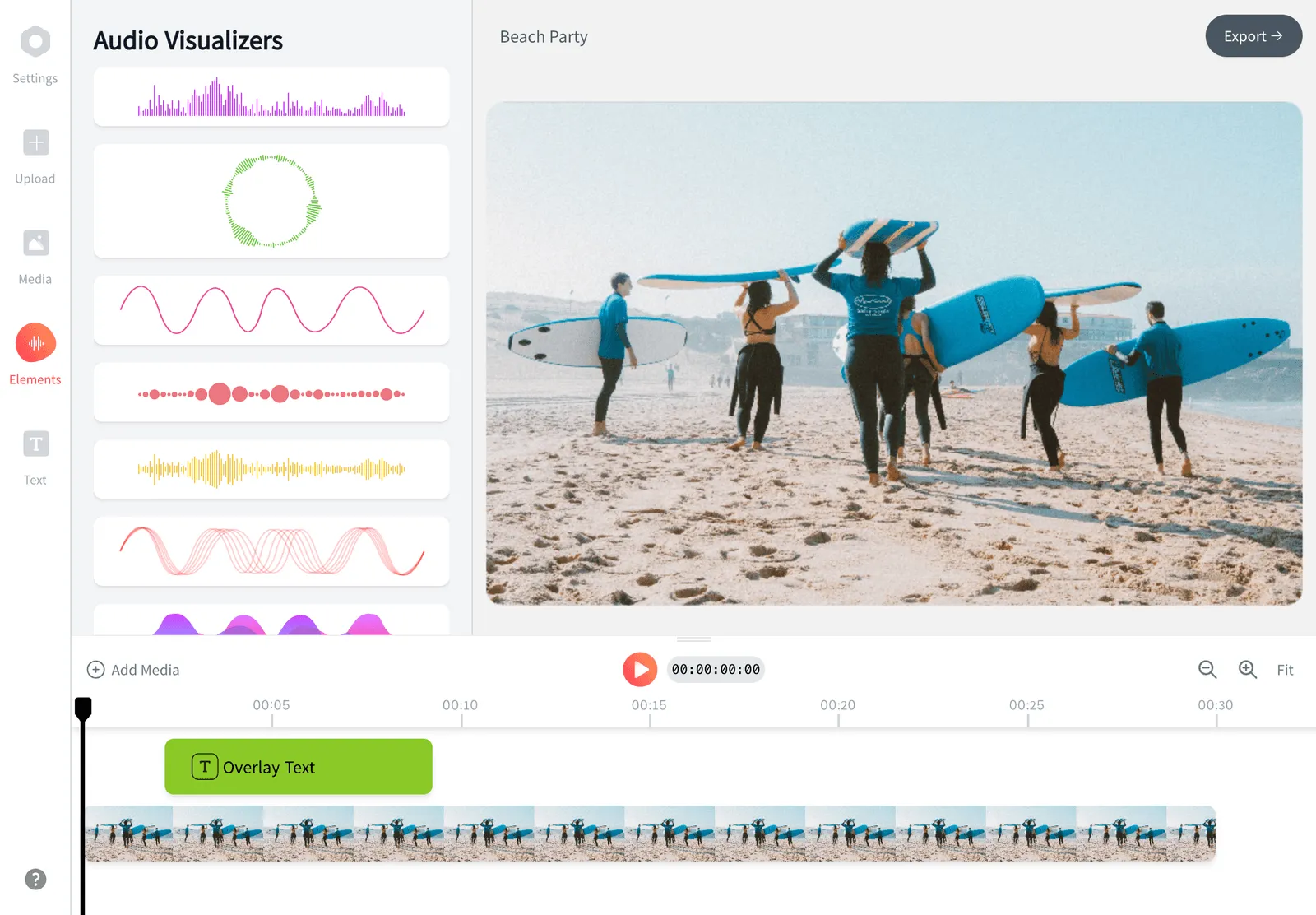
Automate video editing at four levels with EchoWave: one-click AI tools that cut silences, strip filler words and caption speech inside the editor, an AI clip generator that turns one long recording into 1-30 scored, captioned clips, templates with placeholders that batch-render up to 100 videos from one CSV, and a REST API plus MCP server so your scripts and AI agents can fill templates and trigger renders programmatically. Everything runs in your browser, the free plan exports HD MP4s with a small removable watermark badge, and rendering happens on a cloud render farm, so an old laptop keeps up fine.



Automate Video Editing Features
EchoWave's video automation tools are used by content teams, podcasters, marketers and developers around the world.





Three automation layers
Video editing automation that actually ships
Most guides on how to automate video editing point you at ffmpeg scripts and duct tape. EchoWave builds automation into the editor itself: Echo, an AI video agent, performs multi-step edits on command, the AI clip generator turns one long recording into up to 30 clips, each carrying a Viral Score of 0-100 with sub-scores for Hook, Clarity, Emotion, Value and Trend and plain-English reasons, templates turn a finished project into a bulk video generator, and a video editing API renders those templates from your own code. Manual editing stays a first-class option: every automated result, including each camera move in a generated clip, is ordinary keyframes you can adjust shot by shot in the editor.
-
39
Echo editing tools
-
100
renders per CSV batch
-
176
caption presets
-
63
AI voices
What you can automate
From one-click cleanup to hands-off rendering
Start with the repetitive edits, then template the whole project and let the render farm do the volume.
-
Silence and filler words removed in one pass
EchoWave transcribes your footage and flags every pause, um and uh so you can delete them all at once instead of scrubbing the timeline. The silence remover and filler word remover work from the transcript, so a rambling 20-minute take tightens up in a few clicks.
-
Automate video editing with Echo, the built-in assistant
Echo is a chat panel inside the editor with 39 editing tools. Tell it to cut the dead air, caption the clip in a karaoke style, add a zoom pop at 0:42 and speed up the intro, and it runs each step, previewing rendered frames to check its own work. It saves a checkpoint before big changes, so one click reverts everything.
-
Captions that generate and style themselves
Automatic speech-to-text with word-level timestamps turns into styled captions from 176 presets, including hormozi and Beast Mode karaoke styles with active-word fill. Subtitles translate into 86 languages, and you can export SRT, VTT, TXT or JSON alongside the burned-in version.
-
Templates with placeholders
Mark any text, image, video or audio layer in a finished project as a placeholder. Swapping the media spins up a new version while fonts, timing, animations and brand colors stay locked, which is how one edit becomes fifty.
-
Batch rendering from a CSV
Upload a spreadsheet and EchoWave renders one video per row, up to 100 per batch, filling each placeholder from the matching column. The bulk video generator page walks through the CSV format and a full example.
-
A REST API built for rendering
With an API key your code can list templates, fill placeholders, kick off single or batch renders and poll status until files are ready; a separate endpoint, POST /api/v1/clips, generates AI clips from a long recording with no template involved. One honest note on scope: template rendering fills placeholders rather than free-form timeline editing. The video editing API page has endpoints and examples.
-
An MCP server for AI agents
Install the echowave-mcp package from npm and Claude Desktop, Claude Code or any other MCP client can browse your templates, fill them and request renders, or call generate_clips to turn a long recording into scored, captioned clips, all as one step in a larger agent workflow. Pair it with an LLM that drafts your copy and the whole pipeline runs from a prompt.
-
Cloud rendering at any volume
Every render runs on EchoWave's cloud render farm, so a 100-row batch never touches your CPU and device hardware does not cap output quality. Free renders export as HD 720p MP4 with a small removable EchoWave watermark badge, and paid plans remove the badge and raise the ceiling: 1080p on Basic, 1440p and 4K on Pro, and 8K or 120fps on Business.
-
Generate Clips From a Long Recording via API
POST /api/v1/clips, or MCP's generate_clips, turns one long recording into 1-30 ranked clips, each carrying a Viral Score of 0-100 across Hook, Clarity, Emotion, Value and Trend plus a title, hook line, hashtags and word-timed captions. A prompt search over the transcript, such as 'find moments about pricing', pulls topic-specific clips, and search_clip_moments does the same from an agent.
-
Speaker-Aware Reframing With Seven Layouts
Generated clips ship with the Smart camera: on-screen speaker detection (lip movement matched to the voice) cuts between people on their turns across seven layouts, Follow speaker, Split, Grid, Presenter + slides, Picture in picture, Fill and Letterbox over blur. Captions come in any of 60+ presets sized for portrait, and every camera move is an editable keyframe.
How it works
How to automate video editing in EchoWave
Build the edit once, then let data and the render farm handle every version after that.
-
Build the master edit
Upload your footage and clean it up fast: auto captions with a preset you like, silence and filler removal from the transcript, brand kit fonts and colors applied. Ask Echo to handle the fiddly steps if you would rather describe the edit than perform it.
-
Turn it into a template
Convert the project to a template and mark the layers that change between versions as placeholders: the hook text, the main clip, the logo, the voice over. Everything you do not mark stays fixed in every render.
-
Feed it data
Fill placeholders by hand for a one-off, upload a CSV for up to 100 renders in a batch, or send the values through the REST API or echowave-mcp from a script or AI agent. Each row or request becomes its own video.
-
Render and collect
Renders run in the cloud while you do something else. Watch progress in the dashboard or poll status over the API, then download the finished MP4s. Free renders are HD 720p with a small removable watermark badge, and paid plans remove it and go up to 4K on Pro and 8K on Business.
Automation in practice
What teams actually automate with EchoWave
-
Batch social clips from one CSV
Design one vertical quote template, then feed it a spreadsheet with a hook line, a background clip and a caption color per row. A hundred rows come back as a hundred rendered clips without opening the editor again.
-
Weekly episode re-renders
Keep your show intro, lower thirds and end card as a template, then use replace-media re-versioning to drop in each week's title, date and thumbnail. The branding never drifts because nobody rebuilds it by hand.
-
Personalized outreach videos
Put a prospect's first name, company logo and a custom opening line in placeholder slots, then render straight from your lead spreadsheet. Sales teams get one video per contact from a single afternoon of template work.
-
Captioning as a default step
Run every clip through auto captions with a saved preset so styling stays identical across your whole library. Word-level timestamps mean the karaoke highlight lands on the right syllable without manual nudging.
-
Tightening talking-head footage
Podcasts, lectures and product demos shed their pauses and filler words through transcript-based cutting. What used to be an hour of razor edits becomes a review-and-confirm pass.
-
Agent-driven rendering
An AI agent drafts the copy, picks a template over echowave-mcp, fills the placeholders and returns a render link. You approve the output instead of producing it.
Compare
How EchoWave compares
| Feature | EchoWave | Descript | Creatomate | Shotstack |
|---|---|---|---|---|
| Full manual timeline editor | Yes | Yes | templates only | basic studio |
| Auto captions with styled presets | yes (176 presets) | Yes | Yes | Yes |
| Automatic silence and filler removal | Yes | Yes | No | No |
| In-editor AI assistant that performs edits | yes (Echo, 39 tools) | yes (Underlord) | No | No |
| Templates with placeholders | Yes | limited | Yes | Yes |
| Bulk rendering from a CSV | yes (100 rows per batch) | No | Yes | Yes |
| REST API for template rendering | Yes | No | Yes | Yes |
| Published MCP server for AI agents | yes (echowave-mcp) | No | No | No |
| API can edit timelines free-form | no (template fill and render) | No | yes (JSON) | yes (edit API) |
| AI auto-clipping of highlights | yes (POST /api/v1/clips) | Yes | No | No |
| Direct social publishing | No | Yes | No | No |
| AI voice over included | yes (63 voices) | Yes | No | yes (Create API) |
Based on each tool's public pages as of July 2026. Descript centers on in-editor AI, while Creatomate and Shotstack are developer rendering platforms; EchoWave covers all three: in-editor AI, template fill and render, and a separate AI clip generation endpoint.
Automate the boring half of editing
Captions, silence cuts, branded re-renders and batch versions are machine work. Build the edit once in EchoWave, template it, and spend your time on the footage that needs a human.
What people are saying about EchoWave

About the EchoWave team
EchoWave is a browser-based video and audio editor built by Lemon Vault LLC since 2018. The people who build the editor write these guides and test every step in the production app before publishing.
Automate Video Editing FAQ
What is the best way to automate video editing?
Match the layer of automation to the job. For single videos, use one-click tools like auto captions and transcript-based silence removal inside the editor. For volume, turn a finished edit into a template with placeholders and batch-render up to 100 videos from a CSV. For pipelines, drive those same templates from code through EchoWave's REST API or the echowave-mcp server.
Can AI edit videos for you automatically?
Yes, within limits. Echo, EchoWave's built-in assistant, has 39 editing tools and will split clips, cut silences, style captions, add zoom pops, set keyframes and apply transitions when you describe what you want, checking rendered frames as it works. It also saves a checkpoint before big changes so you can revert everything in one click. You still review the result, which is faster than performing every edit yourself.
How do I batch-create videos from a spreadsheet?
Build one project in EchoWave, convert it to a template, and mark the changing layers as placeholders for text, image, video or audio. Then upload a CSV where each column maps to a placeholder and each row becomes a video, up to 100 renders per batch. The renders run on EchoWave's cloud farm, so your computer stays free while the batch processes.
Can I automate video editing without writing code?
Yes. The transcript tools, Echo assistant, templates and CSV batch rendering all work from the browser with no code at all. The REST API and MCP server exist for teams that want renders triggered from scripts, apps or AI agents, but they are optional extras rather than requirements.
Does EchoWave have an API for automated video editing?
Yes, a REST API with API keys plus an MCP server published on npm as echowave-mcp. Your code or agent can list templates, fill placeholders, start single or batch renders and poll status, or call POST /api/v1/clips (MCP generate_clips) to turn a long recording into scored, captioned clips with no template needed. Scope matters here: template rendering fills placeholders rather than free-form timeline edits, which stay inside the editor; clip generation is its own separate endpoint.
Can AI agents like Claude render videos with EchoWave?
Yes. Install echowave-mcp and MCP clients such as Claude Desktop and Claude Code can browse your templates, fill placeholders and request renders, or call generate_clips to turn a long recording into scored, captioned clips, as part of a longer workflow. A common setup has the agent draft the copy, drop it into a template and hand back a link to the finished render.
Is automated video editing free?
Yes. The free plan covers uploading, editing, auto captions, silence removal, Echo and exporting: free renders come out as HD 720p MP4 with a small removable EchoWave watermark badge and a short branded end card. Paid plans remove the badge and end card and raise quality, with 1080p from Basic, 4K on Pro and 8K on Business, plus extra formats like WebM, MOV and GIF. Teams running CSV batches or the API at volume usually pick a paid tier for badge-free files.
Will automation replace video editors?
No. Automation clears the repetitive work: transcribing, cutting silences, restyling captions, re-rendering the same branded format fifty times. Choosing the story, pacing a cut and judging what feels right still need a person, which is exactly why offloading the mechanical steps is worth it.
Which editing tasks should I automate first?
Start with whatever repeats on every video: captions, silence and filler removal, and your intro and outro branding. Those three eat the most hours and need the least judgment. Once they are handled, template your best-performing format and move to CSV batches or the API when the volume justifies it.
Can I generate clips automatically through the API or MCP, without building a template?
Yes. Clip generation is separate from template rendering. POST /api/v1/clips, or the generate_clips MCP tool, takes one long recording and returns 1-30 ranked clips, each with a Viral Score of 0-100, sub-scores for Hook, Clarity, Emotion, Value and Trend, and plain-English reasons like 'strong hook'. Every clip arrives with an AI title, hashtags, word-timed captions in any of 60+ styles, and speaker-aware reframing across seven camera layouts driven by on-screen speaker detection (lip movement matched to the voice). Materialize any clip into a normal project and render through the same API. Analysis counts against plan minutes, 30 free per month, and free exports carry a small watermark at 720p.
What parts of the workflow can't EchoWave automate yet?
Be aware of the honest gaps. EchoWave does not schedule or publish posts to social platforms, generate AI B-roll, dub or clone voices, record multi-guest remote sessions, or watch an RSS feed for new episodes. It also cannot pull a video from a YouTube or TikTok link: upload the file, pick it from your library, point at a direct media link or start from an existing project. Everything downstream of the file is genuinely automated, finding highlights, reframing, captioning, templating and rendering, and every result opens in the editor when you want manual control.
Ready to automate your next batch?
Edit and export free in HD with a small watermark badge, or go paid to remove the badge and render up to 4K, with 8K on Business.
Get Started →