Video Editing API
EchoWave's video editing API turns templates you design into finished MP4s over plain REST. Build the video once in the visual editor, mark the text, image, video, and audio layers that change as placeholders, then render any variation from a JSON payload. Send up to 100 rows of CSV data in one batch call, poll render status, and download the file. Rendering runs on EchoWave's cloud farm, so there is no FFmpeg to host and no queue to scale.


Video Editing API Features
EchoWave's video editing API is used by developers, marketing teams, and agent builders around the world.





For developers
A video editing API with a real editor behind it
Most video editing APIs make you describe every clip in JSON. EchoWave takes a different route: build the design visually, then automate the fills. That makes it a natural engine for a bulk video generator pipeline, and anyone on the team can adjust the template in the online video editor without touching your integration code.
-
100
rows per batch render
-
176
caption presets in templates
-
93
music visualizer styles
-
4K
cloud rendering on Pro plans
The API surface
Everything the endpoints and MCP server can do
A small, documented surface: templates in, rendered MP4s out.
-
What the video editing API covers
A small surface over REST with API key auth: list your templates and their placeholders, start a render with placeholder values, start a batch render, and poll status until the file is ready. That is the whole surface, so integrations stay small. It is a template-render API by design, honest and predictable, rather than a raw per-frame editing engine.
-
Placeholders for text, image, video, and audio
Mark any layer in a template as a placeholder and it becomes a field in the render payload. Swap a product shot, a headline, a background clip, or a voice over file per render. Everything else in the design stays locked, so every output keeps the same animations, captions, and timing.
-
Batch render up to 100 rows
Send up to 100 rows of data in one batch call and get back a render per row. The same CSV upload works inside the app, so marketers can run a list themselves while your service handles scheduled jobs. Pair it with an automated video editing workflow to keep weekly content moving without manual exports.
-
Poll status, download the file
Every render returns a job id you can poll until it finishes. Jobs run on EchoWave's cloud render farm, the same pipeline behind the editor's export button, so what you previewed is what the API produces. When status reports done, fetch the file and store it wherever your stack needs it.
-
An MCP server for AI agents
The published npm package echowave-mcp exposes the same operations to Claude Desktop, Claude Code, and other MCP clients. An AI video agent can list your templates, fill placeholders, and start renders in conversation, no glue code required. The server authenticates with the same API keys as the REST endpoints.
-
Templates designed in a full editor
Templates come out of EchoWave's editor: a multi-track timeline with keyframe animation, 176 caption presets, 81 text and element animations, and 56 transitions. Designers set the look once and developers never hand-write coordinates. Update the template and future renders pick up the change.
-
Cloud rendering, zero infrastructure
There is no FFmpeg binary to maintain, no render queue to autoscale, and no GPU box to watch. EchoWave's render farm handles the encoding and returns MP4 by default, with WebM, MOV, GIF, and audio formats on paid tiers, up to 4K on Pro, with 8K and 120fps on Business.
-
Captions, voice over, and visualizers travel with the template
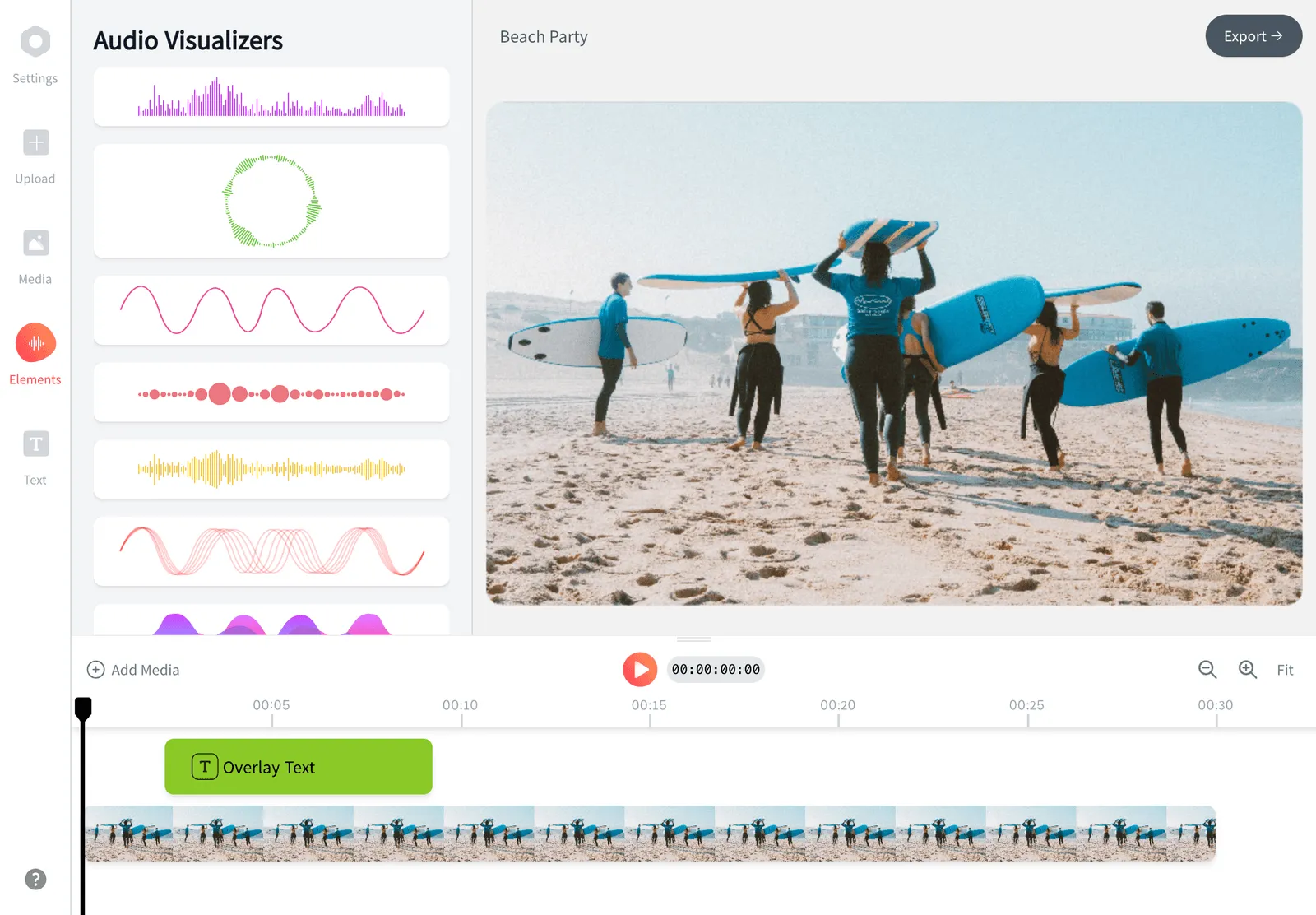
Anything you build in the editor ships with the template: captions styled from 176 presets including word-by-word karaoke looks, AI voice over generated from 63 voices, music visualizers in 93 styles. API renders reproduce it exactly as designed. For per-render spoken lines, generate the voice over in the editor and swap it in through an audio placeholder.
How it works
How to render video with the API
From a blank canvas to programmatic MP4s in four steps.
-
Design a template in the editor
Build the video once: timeline, animations, captions, music. Mark the layers that should change per render as placeholders for text, image, video, or audio. The editor is free to use, and the free plan exports HD renders up to 720p with a small removable EchoWave watermark badge.
-
Create an API key
Generate a key from your EchoWave account and send it with each request. Call the list endpoint to confirm your template is available, then fetch its placeholder names so you know exactly what the render payload expects.
-
POST a render, single or batch
Send the template id with a value for each placeholder to start one render, or attach up to 100 rows of data for a batch. Each job returns an id immediately while the cloud farm does the work.
-
Poll status and download
Check the status endpoint until the render reports done, then download the MP4. On a schedule, the whole loop is a short script. Inside an MCP client, the agent runs it for you.
Built with it
What teams automate with EchoWave
-
Personalized outreach at scale
Drop each prospect's name, company, and logo into placeholders and render a video per row of your CRM export. A hundred custom videos come out of one batch call.
-
Product videos from a catalog
Map product titles, prices, and photos from your store export onto a template and render the whole range. Rerun the batch whenever the catalog changes.
-
Localized campaign variants
Duplicate a campaign across markets by feeding translated copy into the same template's text placeholders. One design, one integration, every language your team writes.
-
Podcast and audiogram clips
Build an audiogram template with one of 93 visualizer styles, then feed each episode's audio and title through the API. Weekly clips render without anyone opening the editor.
-
Agent-driven pipelines
Wire echowave-mcp into Claude Desktop or Claude Code and let an agent pick the template, fill fields from a brief, and start renders. Status checks happen in the same conversation.
-
Listings and real estate videos
Feed address, price, and photo placeholders straight from your listings feed and render a pan-and-zoom video per property. New listings become videos the moment they land in the data.
Compare
How EchoWave compares
| Feature | EchoWave | Shotstack | Creatomate | JSON2Video |
|---|---|---|---|---|
| Template render via REST API | Yes | Yes | Yes | Yes |
| Granular timeline JSON editing | no (templates only) | Yes | Yes | Yes |
| Visual editor for building templates | yes (full editor) | yes (Studio) | Yes | Yes |
| Published MCP server for AI agents | yes (echowave-mcp) | No | No | Yes |
| Batch render from CSV data | yes (100 rows) | via code | Yes | via code |
| Render status polling | Yes | Yes | Yes | Yes |
| Webhook callbacks | no (polling) | Yes | Yes | Yes |
| Official SDK libraries | no (plain REST) | Yes | Yes | Yes |
| Word-by-word caption presets | yes (176) | limited | yes (custom styles) | limited |
| Music visualizer scenes | yes (93 styles) | No | No | No |
| 4K rendering | yes (Pro) | Yes | Yes | Yes |
| Free exports | yes (720p, watermark badge) | sandbox only | trial only | yes (watermark) |
Based on each tool's public pages as of July 2026. Plans and limits change, so check current pricing pages before you commit to an integration.
Design once, render every variation
Start in the free editor, turn a project into a template with placeholders, and wire the REST API or MCP server into your stack. Free renders download at 720p with a small watermark badge; paid plans remove the badge and raise output to 1080p and up to 4K, with 8K on the Business tier.
How creators use EchoWave in real projects

About the EchoWave team
EchoWave is a browser-based video and audio editor built by Lemon Vault LLC since 2018. The people who build the editor write these guides and test every step in the production app before publishing.
Video Editing API FAQ
What is a video editing API?
A video editing API lets software create or modify videos over HTTP instead of through an editing app. You send a request describing what to render, a cloud service does the encoding, and you get a finished file back. EchoWave's version is template based: you design the video visually, then the API fills placeholders and renders each variation.
Is the EchoWave video editing API free to try?
Yes. The editor is free for designing templates, marking placeholders, and previewing, and the free plan downloads finished renders as HD MP4s up to 720p with a small removable EchoWave watermark badge and a short branded end card, through the app or the API. Paid plans remove the badge and end card and add 1080p up to 4K, 8K and 120fps on the Business tier, and more output formats.
Can the API edit a timeline clip by clip?
No. External access is template fill and render only: list templates, read placeholders, render, batch render, and poll status. If you need granular JSON control over every clip, a dedicated vendor like Shotstack fits better. For free-form edits on EchoWave, open the project in the editor, where Echo, the built-in AI assistant with 39 tools, can split, trim, caption, and animate on command.
How does batch rendering from CSV work?
Each column maps to a placeholder and each row becomes one render, up to 100 rows per batch. You can upload the CSV in the app or send the same data through the API, then poll each job until it completes. It is the engine behind EchoWave's bulk video generator.
What is the echowave-mcp server?
It is a published npm package that exposes EchoWave's template operations to MCP clients such as Claude Desktop and Claude Code. An agent can list templates, read placeholders, start single or batch renders, and check status, authenticating with your API key. It covers the same surface as the REST API, so nothing is hidden behind agent-only endpoints.
How do I know when a render is finished?
Poll the render status endpoint with the job id until it reports complete, then fetch the file. EchoWave does not currently send webhook callbacks, so schedule the check in your worker or let your MCP client handle it. Renders run on a cloud farm, so your own hardware never affects the wait.
What formats and resolutions can it output?
MP4 is always available, and free renders come out in HD up to 720p with a small watermark badge. Basic plans remove the badge and add 1080p, WebM, plus MP3 and M4A audio. Pro adds MOV, GIF, WAV, FLAC, 1440p, and 4K, and Business adds 8K and 120fps. Bitrate, frame rate, and codec controls are available too.
How is EchoWave different from Shotstack or Creatomate?
Shotstack and Creatomate give you granular timeline JSON, so code can position every clip; that is the right tool for building a video product. EchoWave's API is narrower on purpose: templates come out of a full visual editor that non-developers can use, and a published MCP server adds agent access. If your videos are variations on a design rather than arbitrary compositions, the smaller surface is easier to build on and maintain.
Do I need to run FFmpeg or my own servers?
No. Rendering happens on EchoWave's cloud render farm, the same one behind the editor's export button. You call the endpoints and download the result; there is nothing to host, patch, or scale.
Ready to automate your video renders?
Design templates and export watermarked HD renders free in the browser, then add an API key when you are ready to render at scale.
Get Started →