WAV to AAC Converter
Shrink a big WAV into a compact AAC file that streams and plays cleanly on phones and the web. Free, in your browser, no signup, no watermark.

WAV to AAC Converter Features
EchoWave is used by creators, marketers, educators, and businesses to convert and edit media online.





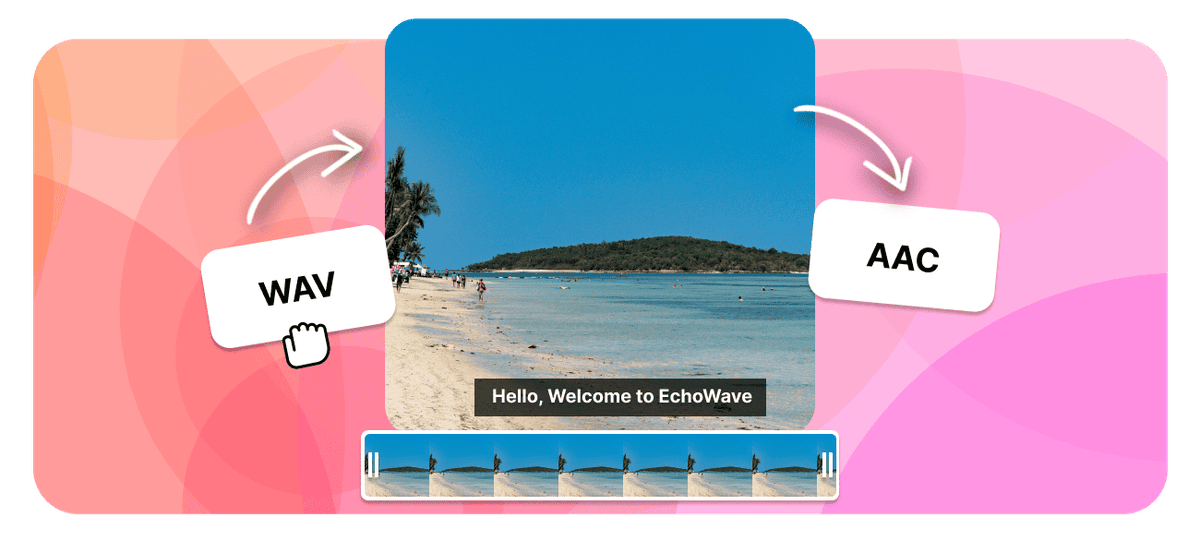
WAV stores raw, uncompressed audio, which is great for editing but heavy to carry around. AAC is the lossy codec that succeeded MP3 and tends to sound a little better at the same bitrate, so it is a strong choice when you want compact audio for streaming, YouTube, or mobile playback. Convert WAV to AAC in your browser, free and with no signup, and download a much smaller file.
How it works
How to convert WAV to AAC
- 1
Upload your WAV
Drag your WAV onto the converter or pick it from your device. Nothing to install.
- 2
Choose AAC and convert
Select AAC as the output, set the bitrate if it applies, then start. Free, with no sign-up.
- 3
Download your AAC
Save the finished AAC, or open it in the editor to trim or adjust it first.
Try it
Estimate your AAC
Pick a bitrate and a length to see the AAC file size before you convert.
Drag to set the clip length in minutes, from 1 to 60.
An estimate. Real size varies a little with the encoder and the audio itself.
The formats
WAV vs AAC
Waveform Audio File Format
Uncompressed studio-quality audio
- Type
- Uncompressed audio
- Holds
- Raw PCM audio, no compression
- Typical size
- Very large, about 10 MB per minute
- Plays on
- Every device and audio editor
Best for:Editing and mastering at full quality
Advanced Audio Coding
The lossy codec that succeeded MP3
- Type
- Lossy audio format
- Holds
- AAC audio only
- Typical size
- Small, efficient at low bitrates
- Plays on
- Phones, browsers, YouTube, and streaming services
Best for:Streaming and mobile audio
Will it lose quality?
- Converting a lossy file to a lossless one cannot restore detail that was already discarded. It only makes a larger file.
- Going from a high-quality source to AAC keeps the sound clear while changing the format.
- Each pass between two lossy formats loses a little, so always convert from the best source you have.
Use cases
What people use it for
Troubleshooting
If something looks off
The AAC is larger than I expected
The song details are missing
My app will not open the AAC
FAQ
WAV to AAC questions
Why convert WAV to AAC?
When converting WAV to AAC, is AAC better than MP3?
Will I lose quality converting WAV to AAC?
What bitrate should I use for AAC?
Is the WAV to AAC converter free?
What plays an AAC file?
Does the WAV to AAC converter work on iPhone, Android, Mac, and Windows?
Once I have an AAC file, what is the difference between AAC and M4A?
How creators use EchoWave in real projects

About the EchoWave team
EchoWave is a browser-based video and audio editor built by Lemon Vault LLC since 2018. The people who build the editor write these guides and test every step in the production app before publishing.
Convert WAV to AAC for free Free online converter
Upload a WAV and get back a small, clean AAC file, with no signup and no watermark.
Convert Files →
Keep converting