How to Make a Podcast Intro
A podcast intro is the first 10 to 30 seconds of an episode, and it is the single most replayed and most skipped part of your show. Listeners decide in those seconds whether to stay. Research from The Podcast Host found that roughly 17 percent of new listeners give a show only five minutes before they bail, and a slow intro burns the first chunk of that window. So the job of the intro is simple: prove the episode is worth their time, then get out of the way.
Quick answer
A strong podcast intro is usually 10 to 30 seconds long. It confirms the listener is in the right place, names the show, makes a clear promise about the episode, and moves into the content fast. Skip the long music bed, the vague slogan, and the host biography that repeats every week. If you want a visual version for social, you can turn the intro into a captioned waveform video with EchoWave in a few minutes, free and in your browser.
How to make a podcast intro in five steps:
- Write a one line hook that works with zero context.
- State the show name clearly.
- Make a specific episode promise.
- Add tight music under the voice, not over it.
- Cut everything that does not earn its second.
How long should a podcast intro be?
Short. The sweet spot for most shows is 10 to 30 seconds for the spoken intro, with any music sting kept to about 3 to 8 seconds. Anything past 30 seconds trains your audience to thumb the skip-forward button, and once they learn that habit they use it on every episode.
Length depends on format, so use this as a starting point:
| Show type | Recommended intro length | Why |
|---|---|---|
| Solo or daily show | 5 to 15 seconds | Listeners are regulars, so get to the point |
| Interview show | 20 to 40 seconds | Room for a cold open clip plus the guest setup |
| Narrative or true crime | 30 to 60 seconds | Mood and tension are part of the product |
| News or commentary | 10 to 20 seconds | Speed signals freshness |
| Trailer or episode zero | 45 to 90 seconds | One time pitch for the whole show |
A useful rule: if your intro is longer than your hook is interesting, cut it. The best test is to listen as a stranger would, with no loyalty and a dozen other shows queued up.
The podcast intro formula
Great intros are not random. They follow a repeatable order that you can reuse every episode while changing the specifics. Here is the modern structure, with an example of each beat.
| Moment | What it does | Example |
|---|---|---|
| Hook or cold open | Opens with your strongest clip or a sharp question | "Most creators lose a sponsor before they ever send the pitch." |
| Show ID | Names the show so people know they are in the right place | "This is Creator Systems." |
| Host line | One short line of who is talking, only if it helps | "I'm Sam, and I've sold ad spots on 400 episodes." |
| Episode promise | The specific payoff, the reason to keep listening | "Today we build a sponsor package that actually closes." |
| Transition | A clean handoff into the content | "Let's get into the numbers." |
You can drop the cold open for short solo episodes and lead with the show ID instead. For interview and story driven shows, the cold open is usually your best hook because it borrows tension from the episode itself.
The two layouts that cover almost everything
- Standard intro: show ID, then host line, then episode promise. Clear and friendly. Best when listeners need to know fast whether the topic fits them.
- Hook intro (cold open): a gripping clip or claim first, then a quick show ID after it lands. Best for interviews, mysteries, and any episode with a dramatic moment buried in the middle. Pull that moment to the front.
What to include in a podcast intro
A real hook
The first sentence should be interesting to someone who has never heard your show. Use a provocative question, a surprising statistic, a one line story, or a hot take. Avoid "hey guys, welcome back" as the opening words, because it carries zero information for a new listener.
The show name
Say it clearly and early. A listener should never finish the intro unsure of what they are listening to. Once is enough, do not repeat your full brand statement every episode.
An episode promise
Tell people what they will understand, learn, or feel by the end. Specific beats hype every time. "How to price your first three sponsorships" pulls harder than "an amazing episode you don't want to miss."
A short host line, if it earns its place
New listeners sometimes need to know who is talking and why your view matters. Keep it to one sentence and tie it to the episode. Long credentials belong in your show notes, not your intro.
Music or sound design
Music sets tone, it does not replace content. Keep the bed noticeably quieter than the voice, fade it under your first words, and keep stings under 8 seconds. Most important, use music you are licensed to use.
Podcast intro music: keep it legal
Using a commercial track without a license is the fastest way to get an episode pulled or hit with a claim. Use royalty free or properly licensed music instead. Common sources:
- Subscription libraries: Epidemic Sound, Soundstripe, Artlist, and Envato Elements license tracks for podcast use.
- Free with attribution: Incompetech (Kevin MacLeod) and the YouTube Audio Library, where you credit the artist.
- Creative Commons: Free Music Archive and ccMixter, as long as you respect the specific license terms.
Whatever you pick, keep the receipt or license confirmation. If your show is monetized, this protects you when a platform runs its automated content scan.
Podcast intro script examples and templates
Here are ready to adapt podcast intro scripts. Swap the brackets for your details, then read them out loud and trim anything that feels slow.
Interview show
"Today on [show name], I'm talking with [guest] about [specific problem]. We get into [specific moment], [specific lesson], and the mistake almost everyone makes when [topic]. I'm [host]. Let's get into it."
Solo expert show
"This is [show name], the show about [theme]. In this episode I'm breaking down [topic], and by the end you'll have [specific outcome] plus a simple way to [action]. Let's start."
Co-hosted show
"Welcome to [show name]. I'm [host one]. And I'm [host two]. This is the show where we [what you do]. Today: [episode topic], and one thing we got completely wrong about it."
Narrative or story show
"In 2018, [event] looked like a small problem. Six months later it had changed [larger consequence]. From [studio or network], this is [show name]."
News or commentary show
"Three things changed this week: [item one], [item two], and [item three]. The one that actually matters is [angle]. This is [show name]."
Ultra short solo template (5 to 10 seconds)
"This is [show name]. I'm [host]. Today, [topic] in under [X] minutes. Go."
Trailer or episode zero
"[Show name] is for [audience] who want [outcome]. Every week, [what you deliver]. New episodes [schedule]. Follow now so you don't miss the first one."
Podcast intro ideas to test
If your current open feels flat, try one of these podcast intro ideas:
- Open mid story, then rewind: "That email cost me a client. Here's what it said."
- Lead with a number: "Forty percent of podcasts never reach episode three."
- Ask the exact question the episode answers.
- Play a five second clip of the best line from later in the episode.
- Name the enemy: "If you've ever been told to just post more, this one's for you."
- Use a recurring signature line so regulars feel at home.

Make the intro earn its seconds
A podcast intro should orient the listener, not delay the episode. Keep the music tight, lead with your strongest line, and move into the payoff quickly. When you want a shareable version, turn the intro into a captioned waveform video and post the clip where new listeners actually scroll.
What creators say after trying EchoWave
How to record and edit your podcast intro
- Write and read aloud. Scripts that look fine on screen often sound stiff. Read your podcast intro script out loud, mark the spots where you stumble, and rewrite for the ear.
- Record clean. Use a quiet room and a consistent mic distance. Record the intro at the same level as the rest of the episode so the join is invisible.
- Tighten the edit. Cut breaths, ums, and dead air. A tight 18 second intro beats a loose 35 second one every time.
- Balance voice and music. Set the voice as the loudest element and tuck music underneath, then fade the music out as you start talking. Aim for a consistent loudness across the episode (most platforms target around -16 LUFS for stereo).
- Reuse a template, vary the specifics. Keep your show ID and music consistent so regulars recognize the show, but write a fresh hook and promise for every episode.
Should you use a podcast intro maker?
A podcast intro maker can be a real time saver, but pick the right type for the job. There are two kinds:
- Audio intro makers build the spoken and musical open. Tools like GarageBand, Audacity, and Descript handle recording, trimming, and mixing music under voice.
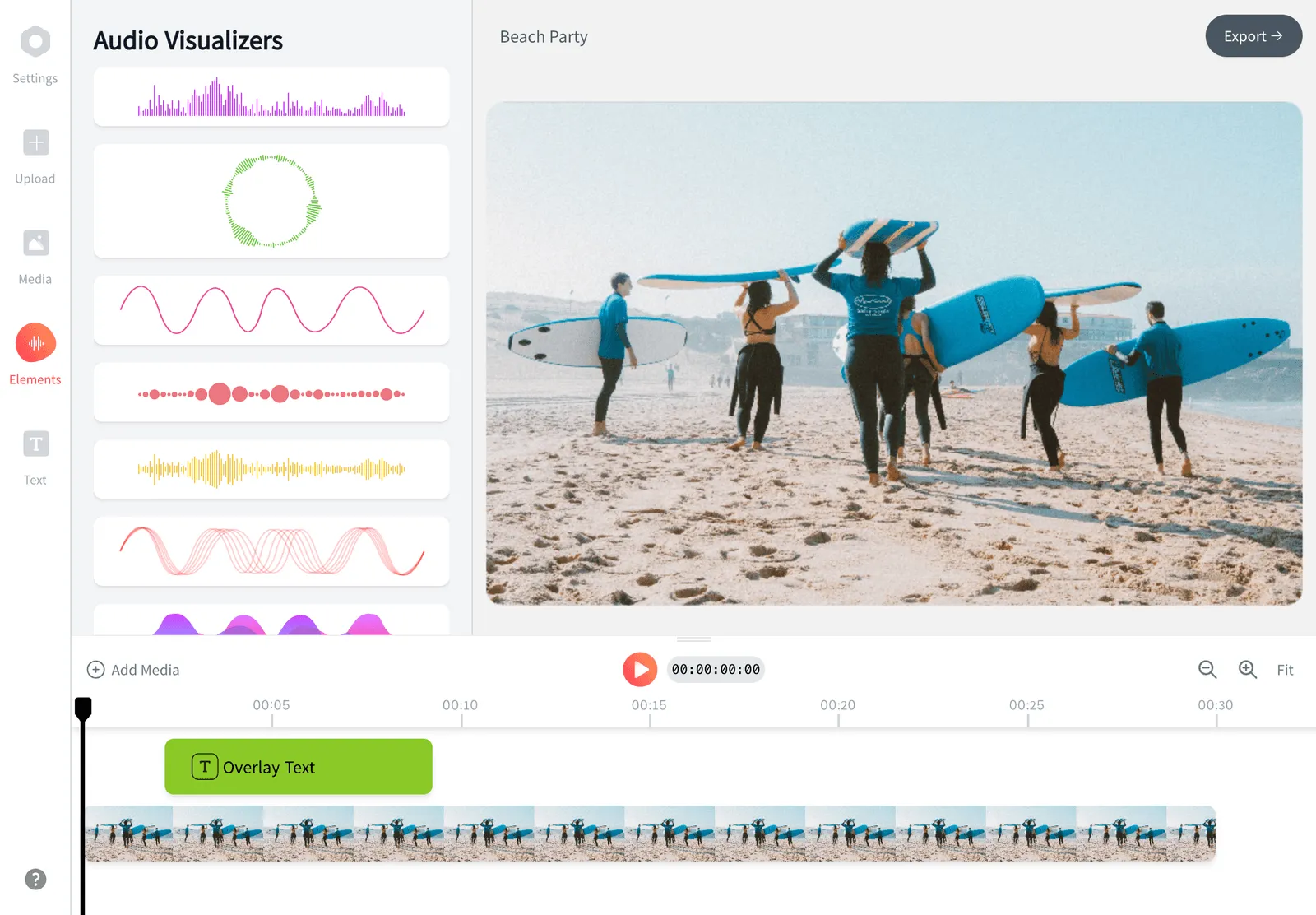
- Video intro makers turn that audio into something you can post. This is where EchoWave fits: drop in your finished intro, add an animated audio waveform, your cover art, and auto captions, then export an MP4 for YouTube, Reels, TikTok, or LinkedIn.
You do not need to pay for a custom voiceover to sound professional. A clear script, a quiet recording, and a tight edit get you 90 percent of the way.
Turn your intro into a video clip that finds new listeners
Audio only intros are invisible on social feeds. The fastest way to grow a podcast is to post short video clips where people already scroll, and your intro or a hook line is perfect source material.
- Lead the clip with your strongest quote, not your show ID.
- Burn in captions immediately, since most feed video plays muted.
- Show the guest, the topic, or an animated waveform so there is motion on screen.
- Keep title text inside the safe zones so it is not cropped by the interface.
- Match the aspect ratio to the platform: 9:16 for Reels, Shorts, and TikTok, 1:1 or 4:5 for the feed.
With EchoWave you can convert the audio into a waveform video, add subtitles, and turn a full episode into video without installing anything.
What to avoid in a podcast intro
- A 60 second music bed before anyone speaks.
- Generic claims like "the best podcast for entrepreneurs."
- Reading the same long host biography every single episode.
- Inside jokes a first time listener cannot follow.
- Voice and music levels that fight each other.
- A sponsor read before the listener knows the episode is worth their time.
Podcast intro production checklist
- Is the first sentence interesting with zero context?
- Is the show name clear within the first few seconds?
- Is the episode promise specific?
- Is the music licensed and credited?
- Are voice and music levels balanced?
- Does it work for a brand new listener?
- Can you cut a 30 second social clip from it?
- Does it end before anyone gets impatient?
Test three intros, then commit
Sources & further reading
- Podcast ad minimum requirements, Spotify Advertising
- Use music and sound effects from the Audio Library, YouTube Help

About the EchoWave team
EchoWave is a browser-based video and audio editor built by Lemon Vault LLC since 2018. The people who build the editor write these guides and test every step in the production app before publishing.
Podcast intro FAQ
How long should a podcast intro be?
Most shows do best with a 10 to 30 second spoken intro and a music sting under 8 seconds. Solo and daily shows can go shorter at 5 to 15 seconds, while narrative shows can run up to 60 seconds because mood is part of the product. Past 30 seconds, listeners start hitting skip.
What should a podcast intro include?
A hook, the show name, an optional one line host introduction, a specific episode promise, and a clean transition into the content. Music is optional and should sit under the voice. Save long credentials and guest bios for your show notes.
How do I write a podcast intro script?
Start with a one line hook that works with no context, name the show, make a specific promise about the episode, then transition in. Write for the ear, read it out loud, and cut anything that feels slow. Reuse the structure each episode and only change the hook and promise.
What is a good podcast intro example?
"Most creators lose a sponsor before they ever pitch. This is Creator Systems. Today we build a sponsor package that actually closes. Let's get into the numbers." It hooks, names the show, promises a payoff, and moves on in about 12 seconds.
Do I need music in my podcast intro?
No, but it helps set tone and makes the show feel polished. If you use it, keep the bed quieter than the voice, fade it under your first words, and only use royalty free or properly licensed tracks so an episode does not get flagged or pulled.
Where can I get free podcast intro music?
Try the YouTube Audio Library and Incompetech (Kevin MacLeod) for free tracks with attribution, or the Free Music Archive for Creative Commons music. Subscription libraries like Epidemic Sound, Soundstripe, and Artlist license tracks for podcast use. Always keep proof of your license.
What is a cold open in a podcast?
A cold open is a hook intro that drops the listener straight into a compelling clip or claim before the show ID plays. It borrows tension from later in the episode to stop people from leaving. It works best for interviews and story driven shows.
Should every episode have the same intro?
Keep your show ID and music consistent so regulars recognize the show, but write a fresh hook and episode promise every time. A recycled, generic intro is the number one reason listeners learn to skip the first 30 seconds of your show.
How do I make a podcast intro for free?
Record your script in a free editor like Audacity or GarageBand, mix in licensed music under your voice, and export. To make a video version for social, use EchoWave's free audio waveform video generator to add a waveform, cover art, and captions, then download an MP4.
Can I turn my podcast intro into a video?
Yes. Upload the audio to EchoWave, add an animated waveform or your cover image, burn in captions, and export an MP4 sized for the platform. Video clips of your intro or best lines are the most reliable way to reach new listeners on Reels, Shorts, and TikTok.
Should I introduce my guest in the intro?
A short guest setup helps in an interview intro: name, one line on why they matter, and the problem you discuss. Save the full bio for the body of the episode or the show notes so the intro stays under 30 seconds.
What is the best way to hook listeners in the first 10 seconds?
Open with the most interesting thing you can say with no setup: a sharp question, a surprising number, a one line story, or a clip of the best moment from later in the episode. Never open with "welcome back" as the very first words.
Ready to make your podcast intro? We have a free plan!
Turn your intro audio into a captioned waveform video for YouTube, Reels, and TikTok. No credit card required, the free plan adds a small Echowave.io watermark.
Get Started →