Best Clip Length for Shorts, Reels and TikTok
YouTube says 3 minutes. Instagram says 20. TikTok is reported at up to 60. The retention data points to a much narrower sweet spot, and this guide shows you exactly where it is. Want a concrete default instead of a guess? Cut clips to a proven length with EchoWave.


Best Clip Length for Shorts, Reels and TikTok Features
The platform lets you post a long video. That does not mean you should. The best clip length for Shorts, Reels and TikTok is not the maximum each platform allows, it is the length your audience actually finishes, and the two numbers are far apart.
The quick version:
- Platform maximums are generous and keep growing: YouTube Shorts allows up to 3 minutes, Instagram Reels can be recorded up to 20 minutes, and TikTok is commonly reported at up to 60 minutes.
- Retention data points the other way. Vidyard's benchmarks show 65% of viewers finish a video under 60 seconds, and Wistia's 2026 report puts videos under 1 minute at about 52% average engagement.
- A practical target for most talking-head clips is 15 to 60 seconds, and you can generate clips at that length automatically instead of trimming by eye.
What creators say after trying EchoWave
Platform maximum lengths in 2026
Start with what each platform actually permits, because outdated articles still quote limits from two or three expansions ago. These are the verified numbers as of September 2026.
| Platform | Maximum length | Notes |
|---|---|---|
| YouTube Shorts | 3 minutes | Recorded with the multi-segment Shorts camera or uploaded as a pre-recorded vertical video, max upload resolution 1080p, per YouTube Help |
| Instagram Reels | 20 minutes recorded | Multi-clip creation in-app is capped at 3 minutes; Instagram's own guidance says Reels over 3 minutes will not be recommended to new audiences |
| TikTok | Reported 3 seconds to 60 minutes | TikTok's consumer help pages were not directly quotable at check time, so treat the 60-minute figure as reported. TikTok's Content Posting API separately defines a per-account max_video_post_duration_sec field, with an example value of 300 seconds, which can cap app-posted videos below the in-app maximum |
Two things to take from this table. First, the three platforms do not share limits, so a single house rule like "keep everything under a minute" is a choice, not a requirement. Second, these numbers change. TikTok and Instagram have both expanded repeatedly, so check the date on any specs guide before you trust it.
Maximum length is not ideal length
The most common mistake in short-form video is reading the platform limit as a recommendation. It is not. The limit is the ceiling on what you are allowed to upload. The ideal length is the point where most viewers still watch to the end, and completion rate is what the recommendation systems reward.
Instagram makes the gap explicit: even though a Reel can be recorded up to 20 minutes, Instagram's own guidance states that Reels over 3 minutes will not be recommended to new audiences. In other words, the platform itself tells you that most of its allowed range works against discovery.
The same logic applies everywhere. A 3-minute Short or a 10-minute TikTok is legal, but every extra second is another chance for a swipe. When a viewer bails at second 40 of a 3-minute clip, your completion rate reads as 22%. The identical moment cut to 45 seconds reads as 89%. Same content, very different signal to the algorithm.
What the retention data actually says
Several large studies converge on the same picture: shorter clips get finished, and finishing is what matters.
- Wistia's 2026 State of Video Report, based on more than 13 million videos, found that videos under 1 minute average about 52% engagement. Engagement declines past the 5-minute mark, and there is a further drop of roughly 11% once videos exceed 30 minutes.
- Vidyard's Business Video Benchmarks, drawing on research with Animoto, found 65% of viewers finish a video under 60 seconds, versus 20% completion for videos over 20 minutes. The same research puts about 47% of a video's perceived value in the first 3 seconds.
- Sprout Social's 2026 short-form video statistics, citing Statista, Meta investor reports and HubSpot's 2026 State of Marketing Report, report the average TikTok video at 42.7 seconds in 2024, up from 39 seconds in 2023, and that 60% of surveyed users prefer content under 60 seconds.
- Socialinsider's analysis of Instagram Reels suggests shorter Reels, roughly 7 to 15 seconds, get watched to completion more often, while cautioning that there is no single universal ideal length and that creators should watch their own retention curves.
No honest source will hand you one perfect number. But the ranges overlap heavily: under 60 seconds is where completion rates are strong, and the first 3 seconds carry a disproportionate share of the value.
Recommended clip length by platform
Combining the verified limits with the retention data, here are defensible targets to put in a style guide. Treat them as starting ranges, not laws.
YouTube Shorts: 20 to 45 seconds. The 3-minute ceiling gives you room, but Vidyard's 65% completion figure for sub-60-second videos argues for staying well under it. If you are turning a long YouTube video into Shorts, one strong idea per clip beats one long clip with three ideas.
Instagram Reels: 15 to 60 seconds, shorter for reach. Socialinsider's data suggests 7 to 15 seconds maximizes completion, which suits punchy, loopable moments. Talking-head clips usually need 30 to 60 seconds to land a point. Whatever you choose, stay under Instagram's 3-minute recommendation threshold if new-audience reach is the goal.
TikTok: 25 to 60 seconds for most clips. Sprout Social's reported average of 42.7 seconds is a useful anchor: that is what people are actually posting, and it sits comfortably inside the 60% of users who prefer content under 60 seconds. The reported 60-minute maximum is for a different kind of content entirely.
Across all three, spend your effort on the first 3 seconds. Vidyard's finding that nearly half of perceived value lands there means the hook does more work than the runtime.
Why EchoWave's length presets are 15-30, 30-60 and 60-90
EchoWave's AI Clip Generator ships four length settings: Auto, Short (15-30 seconds), Medium (30-60 seconds), Long (60-90 seconds), plus a custom range. Those bands map directly onto the data above.
- Short, 15-30 seconds sits in the completion sweet spot Socialinsider identifies for Reels and covers single-punch moments: one claim, one reaction, one joke.
- Medium, 30-60 seconds brackets Sprout Social's reported TikTok average of 42.7 seconds and stays inside the under-60-second zone where Vidyard measured 65% completion. This is the safest default for talking-head and interview clips.
- Long, 60-90 seconds is for moments that need setup and payoff, a full story beat or a complete explanation, while staying far below the drop-off Wistia observes past the 5-minute mark.
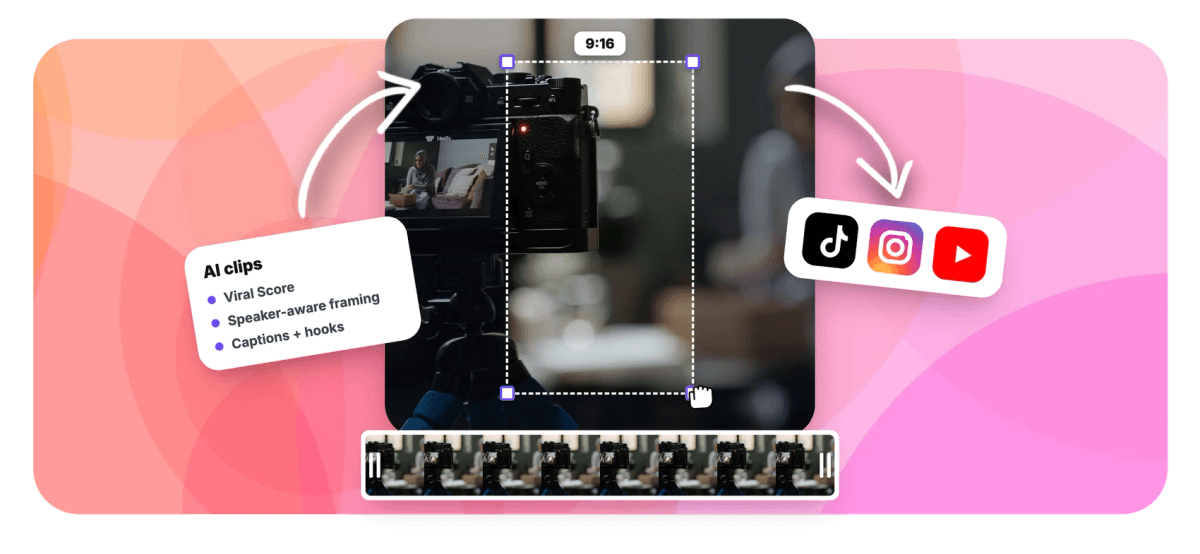
Each generated clip also carries a Viral Score with a Hook sub-score, which matters because the length preset only controls the runtime. The Hook sub-score tells you whether the first seconds earn the rest, which the Vidyard data suggests is the bigger lever. Pick the length, then pick the clips with the strongest hooks.
How to find your own sweet spot
The studies give you a starting range, your analytics give you the answer. Here is a simple test that takes one source video and about ten minutes of setup.
- Cut the same source at two lengths. Generate clips from one long video with the Short preset, then re-run the same source with Medium. EchoWave lets you re-cut at another length from the same upload without starting over, or you can ask Echo, the AI editor, to "make #2 shorter" for a single clip, and the free plan includes 30 analysis minutes a month, enough for a couple of test rounds.
- Post matched pairs. Put the 15-30 second cut of a moment against the 30-60 second cut of the same moment, spaced a few days apart on the same platform.
- Read the retention curve, not the view count. Views are noisy. Average watch percentage and completion rate tell you whether the extra 20 seconds earned their keep. Socialinsider's advice applies here: your own retention curve beats any published average.
- Standardize what wins. Once one band consistently outperforms, write it into your workflow. If you produce vertical clips for multiple platforms, you can hold the length constant and vary only the aspect ratio and captions per platform.
Repeat the test quarterly. Sprout Social's data shows the TikTok average length rising year over year, so the sweet spot drifts, and yesterday's house rule can quietly go stale.
Sources & further reading
All figures in this guide come from the following sources, checked September 3, 2026. Platform limits change, so verify against the primary pages before publishing your own specs.
- YouTube Help, Shorts on YouTube: Shorts length and upload rules.
- Instagram, Reels: Reels recording limits and the 3-minute recommendation guidance.
- Wikipedia, TikTok and TikTok for Developers, Content Posting API: reported TikTok length range and the per-account API duration cap.
- Wistia, 2026 State of Video Report: engagement by video length across 13M+ videos.
- Vidyard, Business Video Benchmarks: completion rates by length and first-3-seconds value, with Animoto.
- Sprout Social, video marketing statistics: average TikTok length and under-60-second preference data.
- Socialinsider, Instagram Reels: Reels completion by length and the case for watching your own retention curve.

About the EchoWave team
EchoWave is a browser-based video and audio editor built by Lemon Vault LLC since 2018. The people who build the editor write these guides and test every step in the production app before publishing.
Clip length FAQ
What is the ideal length for a Shorts, Reels or TikTok video?
There is no single universal ideal, but the data narrows the range. Vidyard's benchmarks show 65% of viewers finish videos under 60 seconds, Sprout Social reports the average TikTok at 42.7 seconds in 2024, and Socialinsider finds Reels around 7 to 15 seconds get completed most often. A practical default: 15 to 30 seconds for punchy single-idea clips, 30 to 60 seconds for talking-head and interview moments, and 60 to 90 seconds only when a story needs setup and payoff. Then check your own retention curve and adjust.
What is the maximum length for a YouTube Short?
YouTube Shorts can be up to 3 minutes long, per YouTube Help. You can record with the multi-segment Shorts camera or upload a pre-recorded vertical video, with a maximum upload resolution of 1080p. Note that 3 minutes is the ceiling, not a recommendation: Wistia's 2026 report shows engagement is strongest under 1 minute, so most creators should cut Shorts to 20 to 45 seconds and reserve the full 3 minutes for content that genuinely needs it.
How long can an Instagram Reel be?
Instagram Reels can be recorded up to 20 minutes across multiple clips, though multi-clip creation inside the app is capped at 3 minutes. More important for reach: Instagram's own guidance says Reels over 3 minutes will not be recommended to new audiences. So while the technical maximum is 20 minutes, staying under 3 minutes protects discovery, and Socialinsider's data suggests the highest completion rates cluster around 7 to 15 seconds.
What is the maximum TikTok video length?
TikTok's general video length is commonly reported at 3 seconds to 60 minutes. TikTok's consumer help pages were not directly quotable at our last check, so treat the 60-minute figure as reported rather than first-party confirmed. Separately, TikTok's Content Posting API defines a per-account max_video_post_duration_sec field, with an example value of 300 seconds, which can cap videos posted through apps below the in-app maximum. Either way, the ceiling is far above the reported 42.7-second average that Sprout Social cites.
Does a shorter video get watched more than a longer one?
On completion rate, yes, decisively. Vidyard's Business Video Benchmarks found 65% of viewers finish a video under 60 seconds, versus 20% completion for videos over 20 minutes. Wistia's 2026 State of Video Report, covering more than 13 million videos, puts sub-1-minute videos at about 52% average engagement, with declines past the 5-minute mark. Length is not the only factor though: Vidyard also found about 47% of a video's perceived value lands in the first 3 seconds, so a short clip with a weak hook still loses.
Is 30 seconds too long for a Shorts video?
No. Thirty seconds sits comfortably inside the sub-60-second zone where Vidyard measured 65% completion, and it is well under the 3-minute Shorts maximum. It is long enough to make one complete point and short enough that most viewers reach the end. The bigger risk at 30 seconds is a slow open: with roughly half the perceived value landing in the first 3 seconds per Vidyard, spend your editing effort on the hook rather than shaving five seconds off the tail.
Do YouTube, Instagram and TikTok all have the same length limits?
No, and the gaps are large. YouTube Shorts allows up to 3 minutes. Instagram Reels can be recorded up to 20 minutes, with in-app multi-clip creation capped at 3 minutes. TikTok is commonly reported at up to 60 minutes. The limits have also changed repeatedly over the years, which is why older specs guides quote numbers that are now wrong. The practical takeaway: do not build your house length rule around any platform's maximum, build it around completion data, which points to under 60 seconds for all three.
What length should I cut my clips to for the best engagement?
Start with 30 to 60 seconds for talking-head, interview and podcast clips, and 15 to 30 seconds for single-punch moments. Those bands match Sprout Social's reported 42.7-second TikTok average and the sub-60-second range where Vidyard measured 65% completion. In EchoWave's AI Clip Generator, that means the Medium preset as your default and Short for reactive moments. Then run your own test: cut the same source at both lengths, post matched pairs, and let your retention curves pick the winner. The free plan's 30 analysis minutes a month covers a test round.
Right length, every clip
Generate clips at 15-30, 30-60 or 60-90 seconds from one long video, free to start.
Get Started →